
Polyurethane (PU) Sealing · Made in Delhi · Supplied Across India
PU Oil Seals — Manufacturer & Supplier in India
PU oil seals are sealing elements moulded from polyurethane — an elastomer selected for one reason: it survives abrasion, tearing and pressure that finishes softer rubbers. Ananta Venture manufactures and supplies PU oil seals for hydraulic cylinders, excavators, tractors, hydraulic presses and industrial machinery, made to your dimensions, drawing or sample — with sizes confirmed before dispatch, not guessed.
*Typical ranges for polyurethane seal grades — confirmed against your fluid, pressure and temperature before ordering.
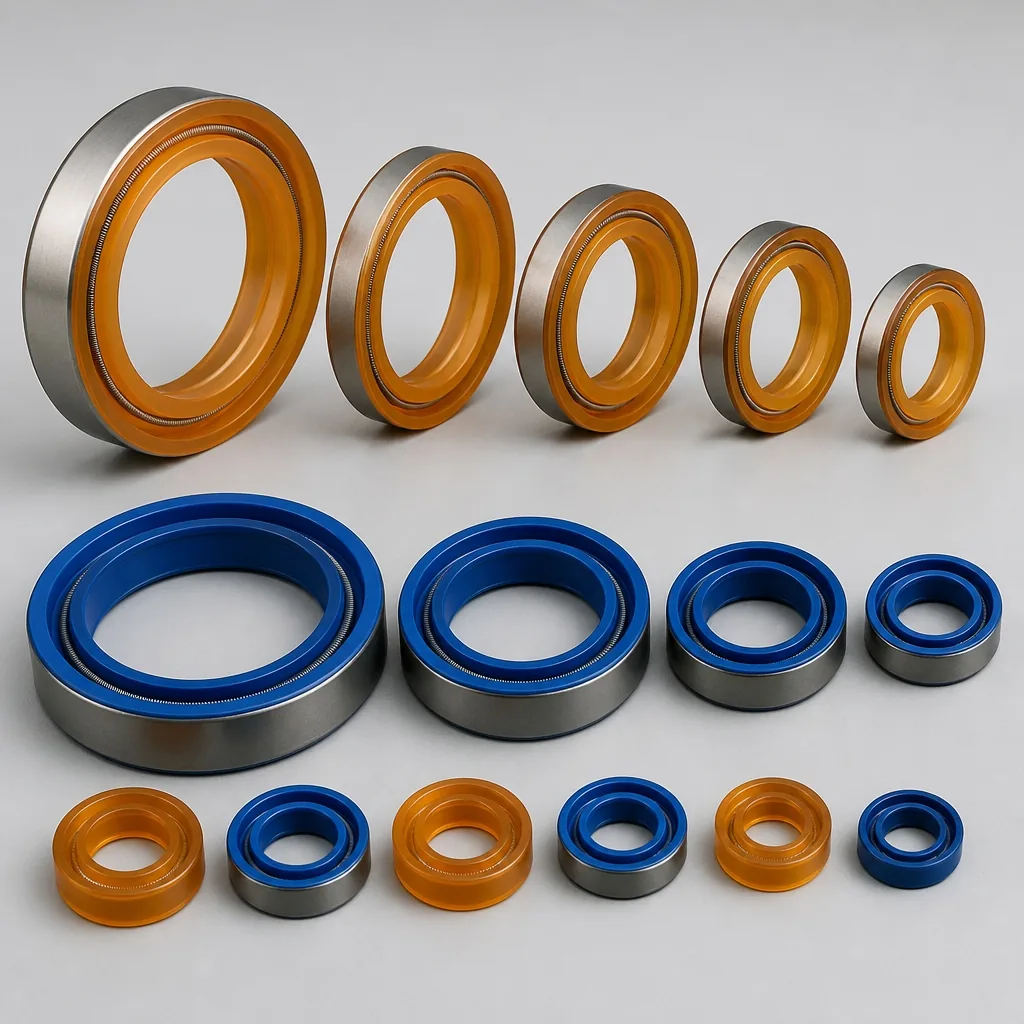
The material & the seal
What Are PU Oil Seals?
A PU oil seal (short for polyurethane oil seal) is a sealing element whose sealing body is made from polyurethane instead of nitrile, fluoroelastomer or silicone rubber. It does the same fundamental job as any oil seal: it closes the gap between a moving shaft and its housing, holds lubricant or hydraulic fluid where it belongs, and keeps dust, water and grit out of the bearing or cylinder chamber.
Polyurethane itself is an elastomer formed by reacting a polyol with an isocyanate. Seal grades are usually thermoplastic polyurethane (TPU) or cast polyurethane, blended to a target hardness — most hydraulic sealing grades sit around 90–93 Shore A. What separates PU from general-purpose rubber is mechanical: it combines high tensile and tear strength with outstanding abrasion resistance and a strong resistance to being forced (extruded) through clearance gaps under pressure.
In service, a PU sealing element keeps fluid in two ways: a pressure-energised lip maintains contact with the moving rod or bore, and the material itself resists the wear that a dirty, shock-loaded machine inflicts on a sealing edge. That is why polyurethane is the mainstream material for hydraulic cylinder rod and piston seals, and a strong candidate for rotary shaft seals on abrasive, low-to-medium-speed duties.
One caution: "PU" names the material family, not the performance. Hardness, lip design, temperature ceiling and fluid tolerance are grade-specific — final suitability is always confirmed against the actual compound and your operating conditions.
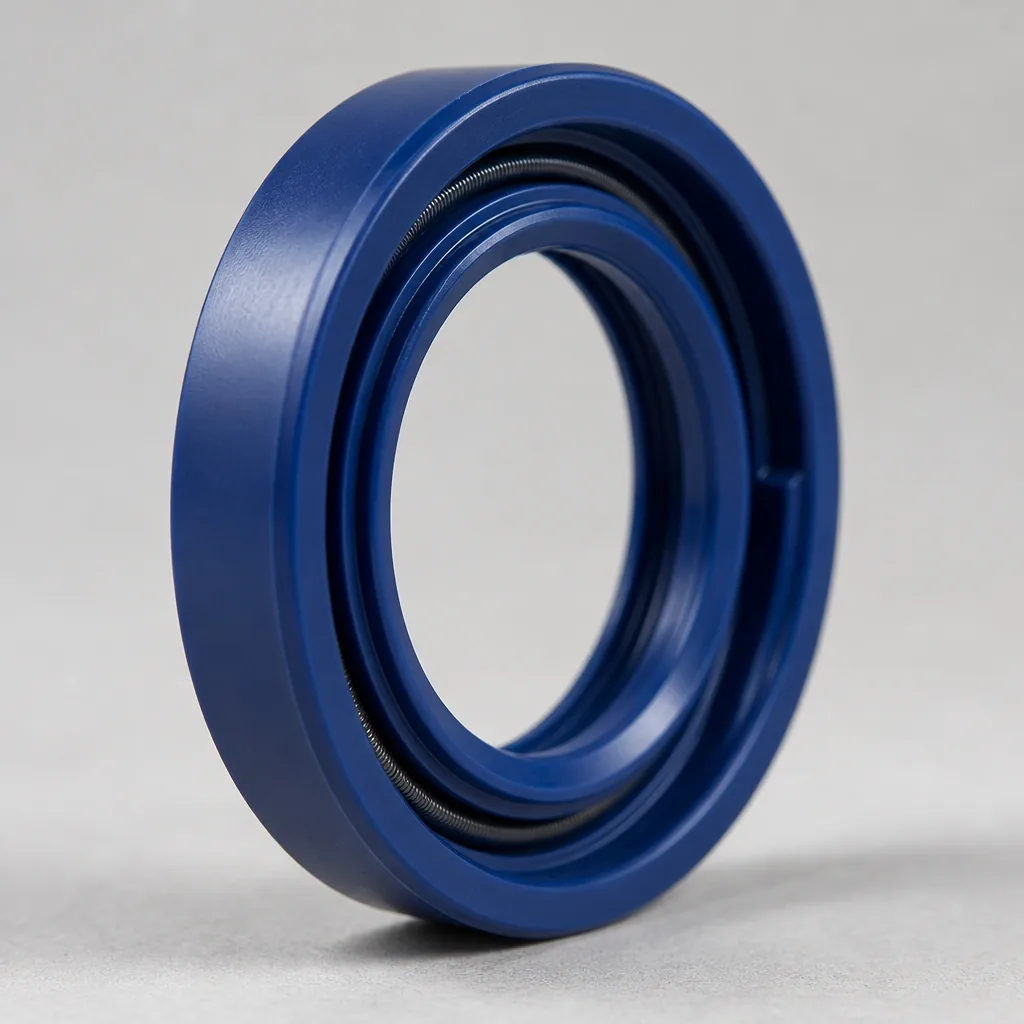
Material advantages
Why Choose Polyurethane Oil Seals?
Polyurethane earns its place in a machine the same way any material does: by holding up where the alternative fails. These are the properties buyers and maintenance engineers actually weigh when they specify PU over softer rubbers.
Abrasion resistance
Polyurethane outlasts general-purpose rubbers where the sealing edge meets grit, sand, slurry or a poorly cleaned rod — the defining advantage on earthmoving and farm machinery.
Mechanical strength
High tensile and tear strength helps the seal resist nibbling, rolling and cutting — failure modes that quickly destroy softer sealing edges.
Wear resistance
On reciprocating rods the sealing edge works every stroke. PU's wear resistance translates directly into longer service intervals and fewer cylinder rebuilds.
Elastic recovery
The material springs back after pressure and load cycles, helping the lip maintain contact instead of taking a permanent set.
Extrusion resistance
Under pressure, softer rubbers squeeze into the clearance gap and fail. PU holds its shape — harder grades especially — which is why it is specified for loaded hydraulic service.
Hydraulic suitability
PU is the mainstream material for reciprocating hydraulic sealing: rod seals, piston seals and wipers on cylinders that work under real pressure.
Important: these are tendencies of the material family, not guarantees. Actual performance depends on the specific PU grade, hardness, seal design, temperature, pressure, fluid compatibility and the operating conditions of your machine. Final selection is confirmed against compound data and the application — never against the material name alone.
Product features
Key Features of PU Oil Seals
Industrial polyurethane grades
Sealing grades specified around 90–93 Shore A, chosen against the fluid, pressure and temperature of the duty.
Made-to-requirement sizes
Standard sections plus custom dimensions to drawing or sample — including large machined diameters.
Compact sections
PU's strength allows slimmer seal cross-sections than many rubber designs, fitting tight cylinder grooves.
Pressure-energised lips
Profiles that improve their own sealing contact as system pressure rises, up to the design limit.
Mineral-oil compatibility
Suits mineral-based hydraulic oils (HM/HV type) and common lubricating oils — fluid confirmed per grade.
Batch consistency
Moulded and inspected with dimensional checks before dispatch, so the seal fits the housing first time.
Application-first selection
Recommendations are made from what the machine does, where it runs and what failed last time.
Direct technical support
Size and material questions answered on phone or WhatsApp by people who deal in sealing daily.
Configurations
Types of PU Oil Seals
"PU oil seal" is used loosely in the market. In practice it covers several distinct sealing families — and mixing them up is one of the most common causes of a wrong enquiry. These are the polyurethane sealing components Ananta Venture supplies.
PU Hydraulic Rod Seals
U-cup and UHS/UNS-type profiles that seal pressurised fluid against the moving rod of a hydraulic cylinder. The workhorse of excavator, press and industrial cylinder sealing. See also hydraulic oil seals.
PU Piston Seals
Wide-section seals fitted on the piston to separate the cylinder's two pressure chambers. Supplied as solid PU profiles and compact designs for higher pressures.
PU U-Cup Seals
Classic U-cross-section seals (UN family) for rod and piston duties. Simple, pressure-energised and economical across low-to-medium duty cycles.
Polyurethane Shaft Seals
Rotary-style seals with a PU sealing element for shafts in abrasive conditions — specified where NBR lips wear early. Metal-cased constructions included.
PU Wipers & Buffer Seals
Related cylinder hardware in PU: wipers that keep contamination off the rod and buffer seals that protect the rod seal from pressure spikes.
Custom PU Profiles
Non-standard sections, combined seal-and-wiper designs and machined large diameters — made to drawing, dimensions or sample.
Rotary oil seals vs reciprocating hydraulic seals — know the difference
A rotary oil seal rides a continuously turning shaft; a reciprocating hydraulic seal works a reversing linear stroke inside a cylinder. They are not interchangeable, and not every hydraulic seal is a conventional rotary oil seal:
| Consideration | Rotary shaft seal | Reciprocating hydraulic seal |
|---|---|---|
| Motion | Continuous rotation against a static housing | Reversing linear stroke inside a cylinder |
| Heat | Generated continuously at the lip — surface speed limits PU suitability | Cyclic; depends on stroke rate and duty cycle |
| Contamination | Dust side usually needs a separate exclusion lip or guard | Normally paired with a wiper on the rod |
| Typical material | NBR or FKM lip with garter spring; PU for abrasive, slower duties | PU is the mainstream choice |
| Common failure | Lip wear, hardening, shaft scoring | Extrusion, nibbling, loss of lip load |
A rod seal is not a shaft seal. Replacing a seal on a rotating shaft? Describe the shaft. Rebuilding a cylinder? Describe the rod or piston. The motion decides the seal family — and the family decides everything that follows.
Size-wise catalogue
PU Oil Seals Sizes and Dimensions
Every PU oil seal is defined by three numbers — inner diameter (ID), outer diameter (OD) and width (W) — plus its profile. Below are commonly requested size ranges; availability and current pricing are confirmed against your dimensions before dispatch.
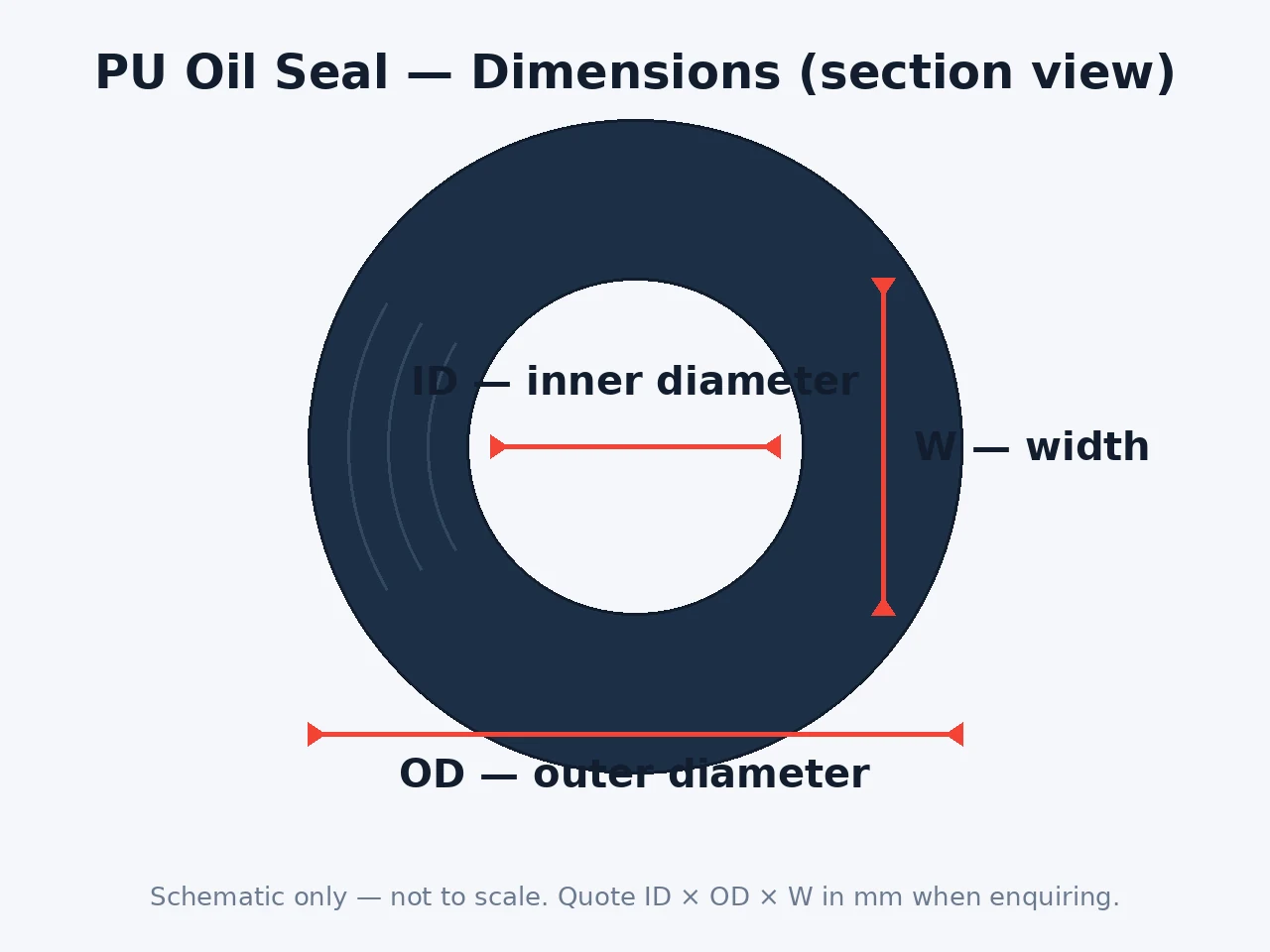
How to read a PU oil seal size
A size written as 20 × 30 × 6 mm means: ID 20 mm (fits the shaft or rod), OD 30 mm (fits the housing bore), width 6 mm (housing depth). For rod seals the ID is the rod diameter; for piston seals the dimension convention can differ (often groove OD first) — always confirm the convention when enquiring.
Measure with a caliper, note the profile family, and check the shaft surface at the sealing point. If the old seal is available, send it — a sample removes every ambiguity.
Find the Right PU Oil Seal — Send Dimensions| Size (ID × OD × W, mm) | Profile family | Material | Typical application | Price |
|---|---|---|---|---|
| 20 × 30 × 6 | PU shaft / U-cup | Polyurethane, 90–93 Sh A | Small hydraulic & rotary shaft sealing | Get Latest Price |
| 20 × 30 × 7.3 | PU shaft / U-cup | Polyurethane, 90–93 Sh A | Small hydraulic & rotary shaft sealing | Get Latest Price |
| 25 × 33 × 5 | Compact / U-cup | Polyurethane, 90–93 Sh A | Compact hydraulic rod sealing | Get Latest Price |
| 25 × 35 × 7.3 | PU shaft / U-cup | Polyurethane, 90–93 Sh A | Hydraulic cylinders, small power packs | Get Latest Price |
| 28 × 36 × 5.8 | Compact / U-cup | Polyurethane, 90–93 Sh A | Compact hydraulic rod sealing | Get Latest Price |
| 28 × 40 × 10 | Piston / wide section | Polyurethane (TPU) | Light hydraulic piston duty | Get Latest Price |
| 30 × 38 × 7 | Compact / U-cup | Polyurethane, 90–93 Sh A | Hydraulic rod sealing | Get Latest Price |
| 30 × 40 × 5 | PU shaft / U-cup | Polyurethane, 90–93 Sh A | Hydraulic & general sealing | Get Latest Price |
| 30 × 40 × 6 | PU shaft / U-cup | Polyurethane, 90–93 Sh A | Hydraulic & general sealing | Get Latest Price |
| 30 × 40 × 7 | PU shaft / U-cup | Polyurethane, 90–93 Sh A | Hydraulic & general sealing | Get Latest Price |
| 35 × 43 × 6 | U-cup (UNS type) | Polyurethane, 90 Sh A | Hydraulic cylinder rod sealing | Get Latest Price |
| 35 × 45 × 6 | U-cup (UHS type) | Polyurethane, 90 Sh A | Hydraulic cylinder rod sealing | Get Latest Price |
| 32 × 42 | Compact / pull-tight | Polyurethane, 90 Sh A | Oil sealing, hydraulic service | Get Latest Price |
| 36 × 46 | Compact / pull-tight | Polyurethane, 90 Sh A | Oil sealing, hydraulic service | Get Latest Price |
| 40 × 50 × 6 | U-cup (UHS/UNS type) | Polyurethane, 90–93 Sh A | Hydraulic rod sealing, cylinders | Get Latest Price |
| 50 × 60 | Compact / pull-tight | Polyurethane, 90 Sh A | Oil sealing, hydraulic service | Get Latest Price |
| 45 × 75 × 20 | Wide-section PU seal | Polyurethane, 95 Sh A | Heavy hydraulic sealing | Get Latest Price |
| 20 × 38 × 10 | PU seal with combi ring | Polyurethane, 95 Sh A | Combined sealing duty | Get Latest Price |
| 110 × 127 × 14.4 | Machined PU seal | Polyurethane, 95 Sh A | Large non-standard hydraulic sealing | Get Latest Price |
| 170 × 200 × 15 | Machined PU rod seal | Polyurethane | Large hydraulic cylinder rod sealing | Get Latest Price |
| 180 mm ID and above | U-cup (UNR type) / machined | Polyurethane | Large rod & piston sealing | Get Latest Price |
| Your dimensions | Any profile, to drawing | Grade to suit duty | Custom PU oil seals | Request Bulk Quotation |
Sizes listed are commonly requested examples drawn from market and catalogue research — not a stock list. Dimension conventions vary between rod and piston profiles; confirm your exact requirement with our team. Larger and non-standard sizes are machined to drawing.
Technical data
Technical Specifications of PU Oil Seals
Specification ranges below are typical for the polyurethane seal families Ananta Venture supplies. Because PU grades and profiles vary, every value is confirmed against your application — fluid, pressure, temperature and movement — before an order is placed. Values needing application-specific confirmation are marked.
| Parameter | Typical specification | Notes |
|---|---|---|
| Material | Thermoplastic polyurethane (TPU/AU); cast PU for special profiles | Grade selected against fluid and duty |
| Hardness | 90–93 Shore A typical (90–95 A available by profile) | Harder grades resist extrusion better |
| Inner diameter (ID) | Commonly quoted from ≈ 10–20 mm ID upward | Large diameters machined to drawing — confirm per enquiry |
| Outer diameter (OD) | Per profile family and housing bore | Confirmed against your housing dimension |
| Width / section | Standard profile sections; custom widths to drawing | groove depth and back-up needs decide section |
| Seal profile | Rod (U-cup, UHS/UNS), piston, compact, wiper, buffer, rotary PU lip | Reciprocating and rotary profiles are not interchangeable |
| Temperature range | ≈ −35 °C to +100 °C continuous; some grades to ≈ +120 °C peak | Grade-specific — confirm cold start and peak temps |
| Pressure suitability | Profile-dependent; U-cup/UHS families commonly ≈ 250 bar, up to ≈ 400 bar with correct design | Material alone has no pressure rating — design decides |
| Fluid compatibility | Mineral hydraulic oils (HM/HV), most mineral oils & greases | Verify water-based fluids; avoid hot water/steam (hydrolysis) and phosphate-ester fluids unless grade-confirmed |
| Manufacturing tolerances | Per agreed drawing / housing requirement | Confirmed before production or dispatch |
| Customisation | Dimensions, hardness, profile and case construction to requirement | Drawing, dimensions or sample based |
Ranges shown are indicative for polyurethane seal families and must be confirmed based on your application — share the operating conditions and our team will confirm the suitable grade and profile. We do not present indicative figures as certified ratings.
Reciprocating sealing
PU Hydraulic Oil Seals
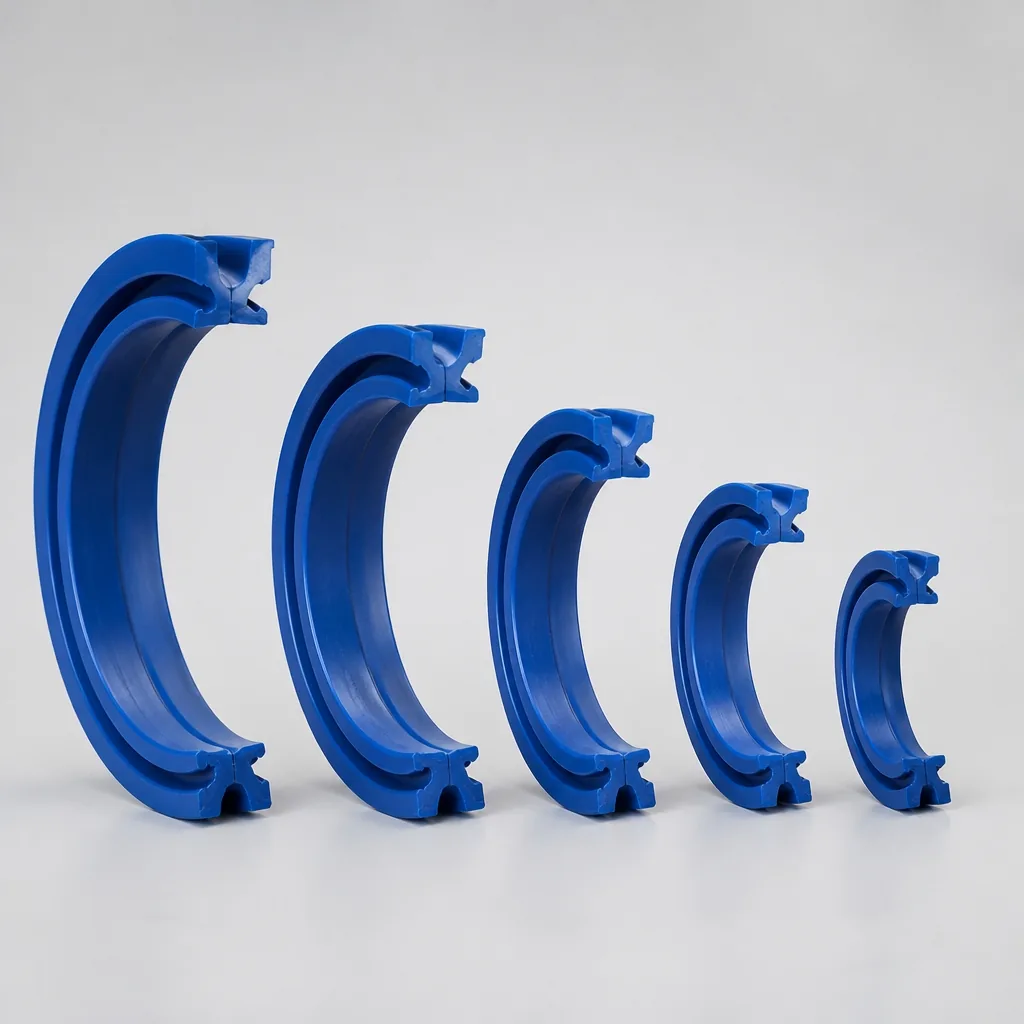
Polyurethane is the mainstream material for hydraulic cylinder sealing — reciprocating seals that see reversing strokes, system pressure and often dirty rods. These are the two primary families:
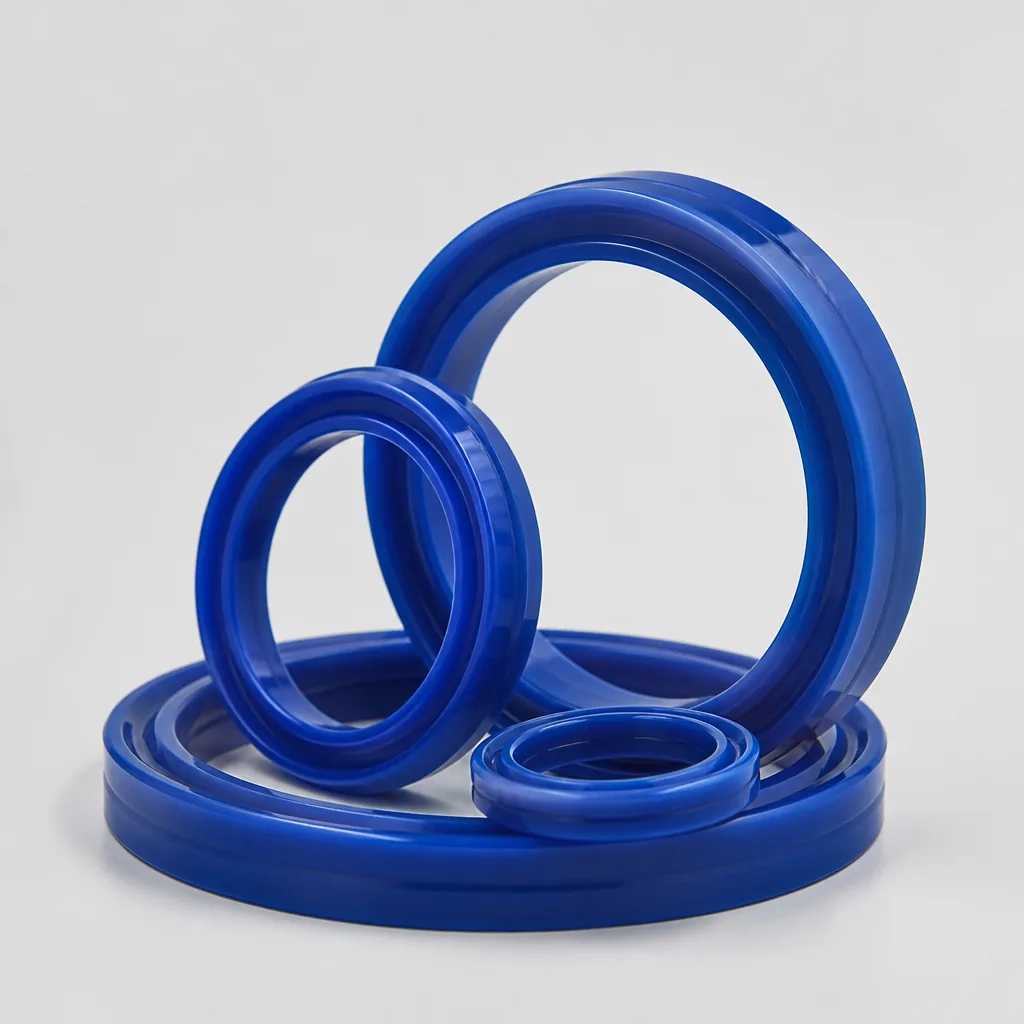
PU piston seals
A piston seal separates the cylinder's two pressure chambers so the piston can transmit force. PU piston seals hold their shape under high differential pressure and resist extrusion through piston clearances; compact designs add anti-extrusion support for the highest pressures. Specify the bore and groove dimensions (and the pressure class) — piston seal conventions are usually quoted groove-first, so confirm the drawing.
PU rod seals
A rod seal contains pressurised fluid where the rod exits the cylinder head — the single most failure-prone sealing point on a cylinder. U-cup and UHS/UNS-type PU rod seals combine a pressure-energised lip with the abrasion resistance to survive dirty rods, typically handling around 250 bar, up to ≈ 400 bar with the correct profile and back-up arrangement.
Pressure note: pressure capability belongs to the whole assembly — profile, clearance, back-up rings, guide rings and rod surface finish — not to the material alone. Share the working and peak pressures when enquiring. More on cylinder sealing: hydraulic oil seals.
Rotary sealing
Polyurethane Shaft Seals
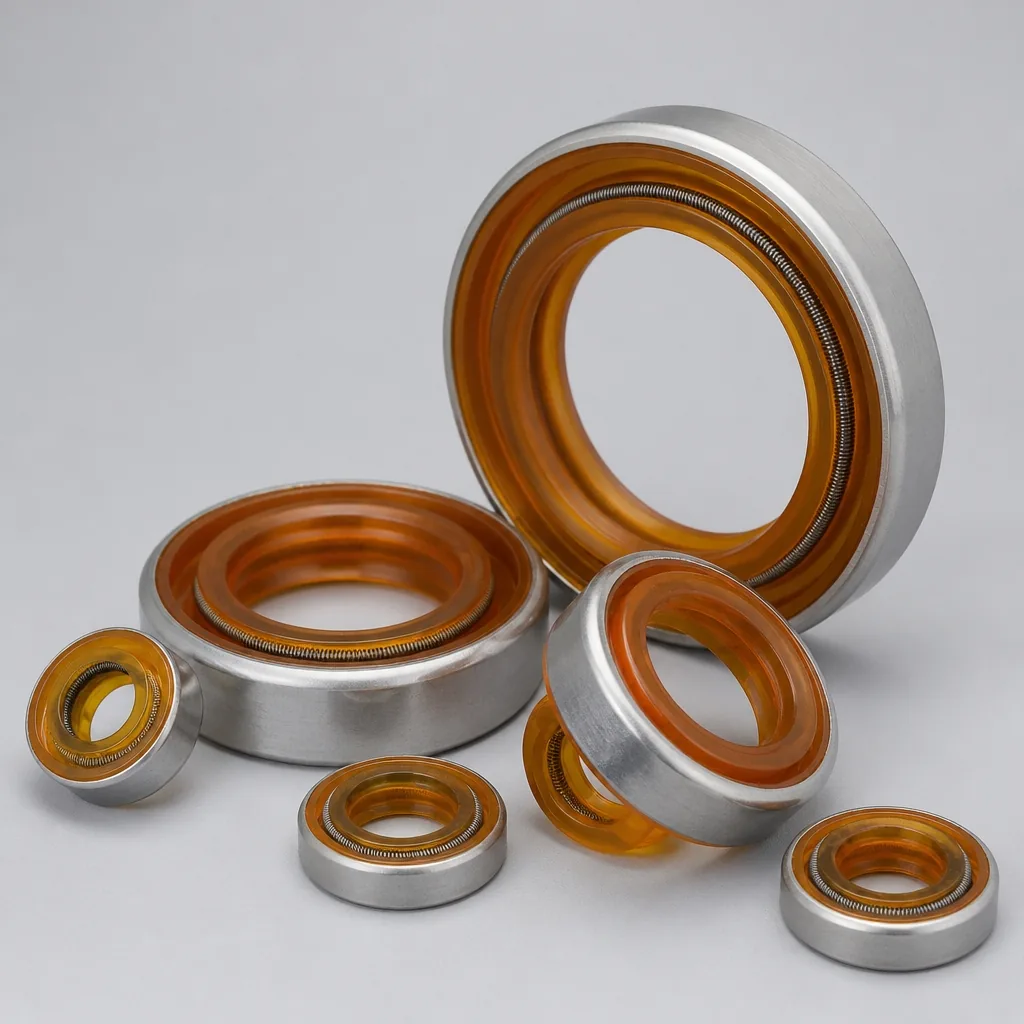
A polyurethane shaft seal seals a rotating shaft — but the duty is fundamentally different from cylinder work. A rotating lip generates heat continuously, which is why most general rotary shaft oil seals use an NBR or FKM lip with a garter spring.
Polyurethane earns its place on rotary shafts in abrasive, dust-laden, slower-speed duties — crushers, farm equipment, slurry and material-handling machinery — where a standard rubber lip wears out early. Where heat or speed dominate instead, FKM is usually the better starting point (high-temperature oil seals).
The rule of thumb: rotating shaft → describe the shaft (speed, surface, temperature); moving rod → describe the cylinder (pressure, stroke, rod condition). Two different sealing problems, two different PU solutions — send the application details and we will confirm which family fits.
Where they work
Industrial Applications of PU Oil Seals
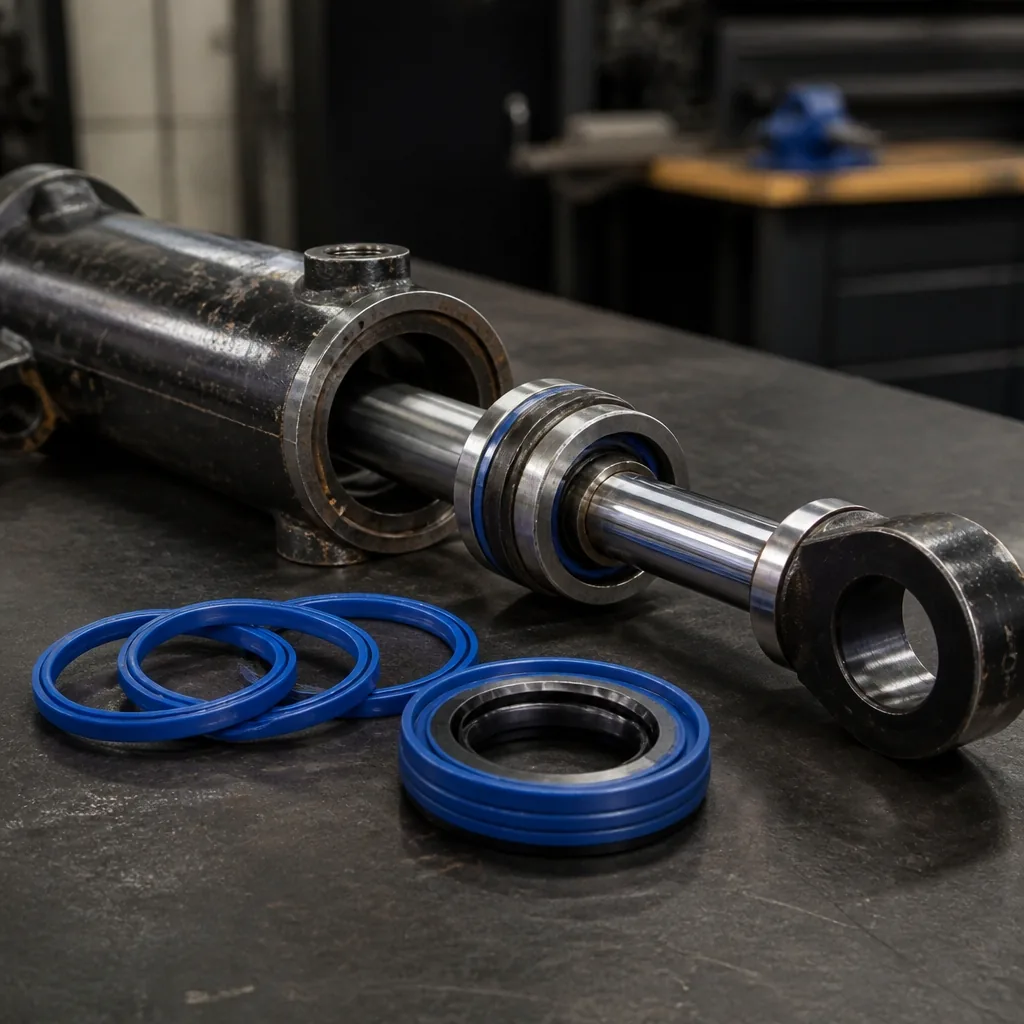
Polyurethane sealing components are usually specified where abrasion, contamination or load is the dominant problem. Typical application areas supplied by Ananta Venture:
Hydraulic cylinders
Rod and piston sealing on cylinders for industrial and mobile machinery — the core PU application. (Hydraulic oil seals)
Hydraulic presses
Main ram and return cylinders where high cyclic pressure rewards PU's extrusion resistance.
Excavators
Boom, arm and bucket cylinder sealing in dust, mud and shock loading. (Excavator oil seals)
JCB & backhoe machinery
Cylinder seal kits with PU rod, piston, wiper and buffer elements for site machinery overhauls.
Agricultural machinery & tractors
Hydraulic lift and steering cylinders plus implement sealing, season after season in soil and crop residue. (Agricultural machinery oil seals)
Forklifts & material handling
Mast, tilt and steer cylinder sealing on equipment that lifts and shocks all day.
Hydraulic pumps & power packs
Application-specific sealing for pump circuits — material confirmed per pump model and fluid.
Construction machinery
Loaders, cranes and earthmoving rams — grit, vibration and overloading punish soft seals first.
Injection moulding machines
Clamp and injection cylinder sealing under high pressure and long duty cycles.
Industrial machinery
Machine tools, compressors and production equipment sealing. (Industrial machinery oil seals)
Wear-out duties
Any assembly where a standard rubber seal keeps failing early — often the clearest signal PU is the right material.
OEM & custom machines
Seals matched to an existing housing or drawing for equipment builders and retrofits.
Machine-wise guide
PU Oil Seals for Different Machines
Which PU sealing products suit which machine — and what size information to send. Exact dimensions are always confirmed against OEM specifications or a sample measurement, never assumed.
| Machine / equipment | Relevant PU sealing products | Typical application | Size information required |
|---|---|---|---|
| JCB / backhoe loaders | PU rod seals (UHS/UNS), piston seals, wipers, buffer seals — cylinder seal kit contents | Boom, bucket and steering cylinder resealing | Cylinder bore, rod Ø, groove dims — or old kit reference |
| Excavators | PU hydraulic cylinder seals (rod, piston, wiper) | Boom / arm / bucket ram rebuilds | Per-cylinder bore × rod × groove; OEM no. if known |
| Tractors | Agricultural hydraulic seals for lift & steering cylinders | Hydraulic lift and steering overhaul | Lift-cylinder dims or old seal measurement |
| Hydraulic presses | PU piston + rod seals, back-up rings | Main ram and return cylinders | Bore, rod, groove widths; large bores machined |
| Hydraulic power packs | Application-specific PU hydraulic seals | Actuator cylinders on pack circuits | Per-actuator drawing or sample |
| Forklifts | PU cylinder seals for mast, tilt, steer | Material-handling cylinder resealing | Per-cylinder dims or old kit reference |
| Injection moulding machines | PU piston + rod seals for clamp & injection units | High-pressure clamp unit sealing | OEM cylinder spec; confirm fluid & temp at seal |
| Hydraulic pumps | Shaft / hydraulic seals confirmed per model (many pump shaft seals remain NBR/FKM) | Pump shaft and internal sealing | Pump model + shaft size |
| Material handling equipment | Hydraulic cylinder PU seals | Loaders, cranes, hoists | Per-cylinder measurement or OEM reference |
| Industrial cylinders (general) | PU rod & piston seals | Cylinder manufacture and repair | Bore, rod, groove dims or housing drawing |
No universal compatibility is implied — a seal that survives a press ram may not suit a pump shaft. Confirm dimensions against OEM specifications or a measured sample before ordering.
Material selection
PU Oil Seals vs NBR vs FKM
Three material families cover most sealing enquiries. Each is strongest at a different job — polyurethane is not universally "better", it is differently strong.
| Characteristic | PU (Polyurethane) | NBR (Nitrile) | FKM (Viton) |
|---|---|---|---|
| Abrasion resistance | Outstanding — the key advantage | Moderate | Good, below PU in gritty duties |
| Temperature | ≈ −35 to +100 °C (peaks ≈ +120 °C by grade) | ≈ −30 to +100/120 °C | ≈ −20 to +200 °C |
| Fluid compatibility | Mineral hydraulic oils & greases; weak in hot water/steam, some solvents | Broad mineral-oil resistance; weak against ozone/some fluids | Broad chemical & heat resistance, grade-specific |
| Mechanical strength | Highest tensile & tear strength; extrusion resistant | Moderate; compliant & forgiving | Moderate; low compression set |
| Typical applications | Hydraulic rod/piston seals, wipers, abrasive duties | General rotary shaft seals, gearboxes, automotive | High-temperature shafts, chemically aggressive service |
| Relative cost | Moderate | Economical | Premium |
Indicative comparison of material families — not a substitute for compound data. Compare in detail: NBR oil seals · Viton (FKM) oil seals · Silicone oil seals · PTFE oil seals · EPDM oil seals.
Buyer's checklist
How to Choose the Right PU Oil Seal?
Work through these ten points in order — each one can eliminate a wrong material or profile before you get to price, which is far cheaper than finding out in service.
1 · Inner diameter (ID)
The shaft or rod diameter at the sealing point. Measure with a caliper and check for wear grooves first.
2 · Outer diameter (OD)
The housing bore the seal presses into. A loose fit lets the seal spin; an oversize one will not enter.
3 · Width (W)
The housing depth available for the seal — including any back-up ring allowance.
4 · Operating pressure
Working pressure plus peaks and shock loads. Decides the profile and back-up design.
5 · Temperature
Continuous temperature at the seal — including start-up cold — against the grade's range.
6 · Hydraulic fluid
The exact fluid family (HM, HV, HFA, water-glycol…). Compatibility is grade-specific — always name it.
7 · Movement type
Static, reciprocating or rotary. This single answer changes the seal family, lip design and material shortlist.
8 · Shaft / rod dimensions & finish
Diameter, surface roughness and condition. A hard PU lip needs the specified finish to seal and to survive.
9 · Machine model / OEM reference
The machine name and any existing part number speed up matching — and prevent convention mix-ups.
10 · Old seal reference
The worn part carries every dimension and the profile family. Send it or a photo — the fastest route to the right seal.
Free size check
Not sure which PU oil seal fits?
Send the dimensions, machine details or a photo of the old seal. We confirm the profile, grade and availability — before you spend money on the wrong part.
The company
PU Oil Seal Manufacturer and Supplier in India
Ananta Venture is a machinery components manufacturer based at West Sant Nagar, Burari, Delhi. Sealing is the core product: the business manufactures oil seals and V belts for industrial, automotive, agricultural and heavy machinery applications, and supplies PU sealing components against requirement — dimensions, drawing or sample.
PU oil seals are quoted and produced per requirement rather than pushed from a fixed published list. Enquiries are handled by people who work with sealing dimensions and lip profiles every day, sizes are confirmed before production or dispatch, and support continues by phone and WhatsApp until the parts are in your hands.
Supply spans Delhi NCR and the rest of India — from single workshop requirements to repeat OEM and distributor volumes. For rubber compounds, the published oil seal price list covers the rubber range; polyurethane seals are priced per size, grade and quantity.
Verified business details
- Works & office: Plot No. 2, 1st Floor, Street No. 7, A Block, West Sant Nagar, Burari, Delhi, India
- Phone: +91 92113 05366
- WhatsApp: +91 92113 05366 — send drawings, photos or samples
- Working days: Open Monday to Sunday
- Supply area: Delhi NCR and pan-India dispatch
- Visitors: walk in with the old seal — matched while you wait
Working with us
Why Choose AnantaVenture for PU Oil Seals?
Sealing is the core product
Oil seals and V belts are what the business makes — enquiries are handled by people who deal with lip profiles and housing fits daily.
Made to requirement
PU seals supplied against your dimensions, drawing or sample — the practical way to match an existing housing or cylinder.
Application-first selection
We ask what the machine does, where it runs and what broke last time — then recommend, instead of selling what is on the shelf.
Dimensional attention
Shaft, bore, width and profile confirmed before production or dispatch — in sealing, a tenth of a millimetre matters.
Direct contact, no layers
Reach the team on phone or WhatsApp and get a straight answer on workability and price — replies in hours, not days.
Delhi NCR base, India-wide supply
Based in Burari, Delhi — close to NCR industrial belts, with dispatch and paperwork handled for pan-India orders.
Oil seals & V belts together
Both components under one roof — one point of contact for the sealing and the power transmission side of the machine.
Honest suitability advice
If a duty calls for a different material family — or a different sealing component — we say so before you order.
Bulk & OEM support
Volume pricing for distributors, OEM buyers and maintenance teams, with repeat-batch consistency batch after batch.
Common questions
Frequently Asked Questions About PU Oil Seals
What are PU oil seals used for?
PU oil seals are used where a seal must hold oil or hydraulic fluid while resisting abrasion, tearing and pressure. The most common uses are hydraulic cylinder rod and piston sealing on excavators, JCB and backhoe loaders, tractors, hydraulic presses, forklifts and industrial cylinders, plus rotary shaft sealing on machines that work in dust, slurry or grit where standard rubber lips wear out early.
Are PU oil seals better than rubber (NBR) oil seals?
Not universally — they are better at different things. Polyurethane outwears nitrile (NBR) in abrasion, tear strength and extrusion resistance, which is why it dominates hydraulic rod and piston sealing on dirty, shock-loaded machines. NBR remains the better choice for most high-speed rotary shaft sealing because a rotating lip builds heat and needs a compliant, spring-loaded compound, and NBR is more economical for general duties. The duty — motion, speed, temperature, fluid and contamination — decides the material, not a fixed ranking.
What is polyurethane (PU) as a seal material?
Polyurethane is an elastomer family formed by reacting a polyol with an isocyanate. Seal grades are usually thermoplastic polyurethane (TPU) or cast polyurethane, typically specified around 90–93 Shore A hardness for hydraulic seals. Its mechanical properties — high tensile and tear strength, outstanding abrasion resistance and resistance to being squeezed through clearance gaps — are what make it valuable in sealing. Grade-specific properties such as temperature ceiling and fluid tolerance must be confirmed against the compound data.
Can PU oil seals handle high hydraulic pressure?
Yes, when the profile and support arrangement are designed for it. PU U-cup and UHS/UNS type rod seals are commonly rated by their manufacturers for working pressures in the region of 250–400 bar depending on the profile, clearances and back-up design. The material itself has no pressure rating — pressure capability belongs to the complete seal assembly, so the working pressure, peaks and shock loads must be confirmed with the supplier before ordering.
Which PU seal profiles are available?
Commonly supplied polyurethane sealing profiles include hydraulic rod seals (U-cup, UHS/UNS type), piston seals, U-cup seals in the UN family, compact seals, wipers and buffer seals for cylinder service, rotary shaft seal constructions with a PU sealing element, and custom profiles made to drawing or sample. Rod and piston profiles are reciprocating seals and are not interchangeable with rotary shaft seals.
What sizes of PU oil seals can Ananta Venture supply?
Seals are made to requirement rather than supplied from a fixed published list. Commonly requested sizes run from small sections such as 20 × 30 × 6 mm upward, with larger and non-standard diameters machined to drawing. Share your shaft or rod diameter, housing or bore size and width — or send the old seal, a drawing or the machine details — and the team confirms what can be supplied before production or dispatch.
Can you make custom PU oil seal dimensions?
Yes. Custom PU oil seals are a core part of the business: non-standard sections, combined seal-and-wiper profiles, special hardness grades and large machined diameters are all supplied against a drawing, dimensions or a sample. Many custom requirements are met with an existing profile in a more suitable grade, so it is worth discussing the duty before assuming new tooling is needed.
Which fluids are PU oil seals compatible with?
Most polyurethane seal grades perform well in mineral-based hydraulic oils and common mineral lubricating oils and greases. Compatibility is grade-specific: hot water and steam can hydrolyse standard PU, and some water-glycol fluids, esters, ketones and phosphate-ester fluids attack it. Always confirm the actual fluid — including start-up cold and peak temperatures — with the supplier before finalising the compound.
Which machines use PU oil seals?
Typical machines include hydraulic cylinders on excavators and JCB-style backhoe loaders, tractors and agricultural harvesters, hydraulic presses, forklifts and material-handling equipment, injection moulding machines, hydraulic power packs and general industrial cylinders. PU is chosen where dust, slurry, shock loads or pressure make softer sealing materials fail early.
What is the price of PU oil seals and how do I get a bulk quotation?
PU oil seal pricing depends on the size, profile, hardness grade and order quantity, so there is no single published price list for polyurethane seals — every requirement is quoted. Send your size list or drawing by phone or WhatsApp to receive a quotation the same working day; distributors, OEMs and bulk buyers receive volume pricing. Call +91 9211305366 or message WhatsApp +91 9211305366.
Enquiry
Get PU Oil Seals at the Right Price — Straight from the Manufacturer
Share your size list, drawing or a photo of the old seal. Ananta Venture confirms the profile, grade and availability, then quotes — by phone, WhatsApp or email, whichever is fastest for you. Bulk and OEM enquiries welcome.
Ananta Venture · West Sant Nagar, Burari, Delhi · Open Monday to Sunday · Supplying Delhi NCR and pan-India.