PTFE, in plain terms
PTFE stands for polytetrafluoroethylene, a fluoropolymer built from carbon and fluorine. The carbon–fluorine bond is exceptionally stable, which is why the material resists attack by many acids, bases, solvents and process chemicals, and why it keeps useful properties across a very wide temperature band. “Teflon” is a brand name that is often used loosely to mean PTFE. In catalogues and enquiries the same component appears as PTFE rotary shaft seals, PTFE shaft seals or Teflon oil seals.
Those properties are the reason PTFE is considered for sealing duties where a rubber lip would swell, harden, crack or wear too quickly. They are also the reason PTFE seals demand more care in specification: the same chemical inertness that makes the material attractive also makes it harder to bond, and its low friction is paired with limited elastic recovery.
Material versus finished seal assembly
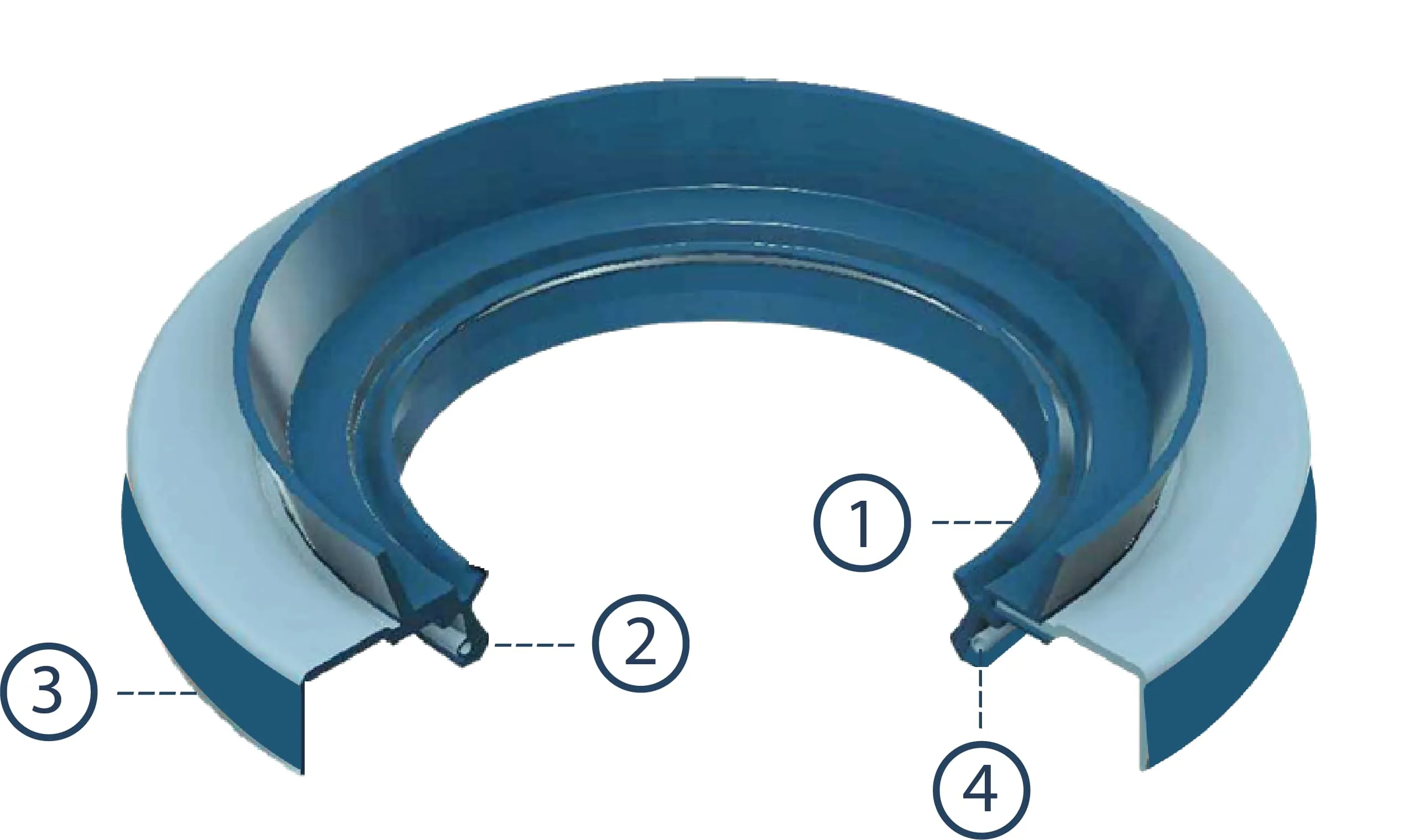
A finished PTFE oil seal is an assembly, not a piece of polymer. It normally contains a PTFE lip element, a metal case or carrier that provides press-fit rigidity and bore retention, an elastomeric gasket or bonded layer between case and element, and in many designs an energiser — a garter spring or elastomeric core — that maintains lip contact load.
Each of those parts can change performance. A spring-energised seal follows shaft runout differently from an unenergised lip; a stainless case behaves differently from zinc-plated steel in a wet or chemical environment; a dual-lip design excludes dust that a single lip would ingest. Two seals made from the same PTFE grade are not interchangeable if their geometry differs.
What actually decides service life
Seal life is the outcome of the whole system: the media and its concentration, operating temperature, shaft speed and surface speed, pressure and pressure pulses, lubrication, shaft hardness and finish, bore and shaft alignment, and the quality of installation. A seal that runs reliably in one pump can fail quickly in a similar pump that runs drier, faster or with more runout.
That is why a PTFE oil seal should be selected from the application backwards — starting with the sealed fluid, the duty cycle and the hardware — rather than from a catalogue size alone. The specification checklist below lists the information a seal supplier needs to make a defensible recommendation.