Oil leakage prevention
The lip closes the gap around the rotating shaft so lubricant stays in the housing rather than escaping onto the pulley, coupling, belt or floor. A dry machine is easier and safer to maintain.

Oil Seals · Compressor & Air Systems
For air, screw, reciprocating & piston compressors
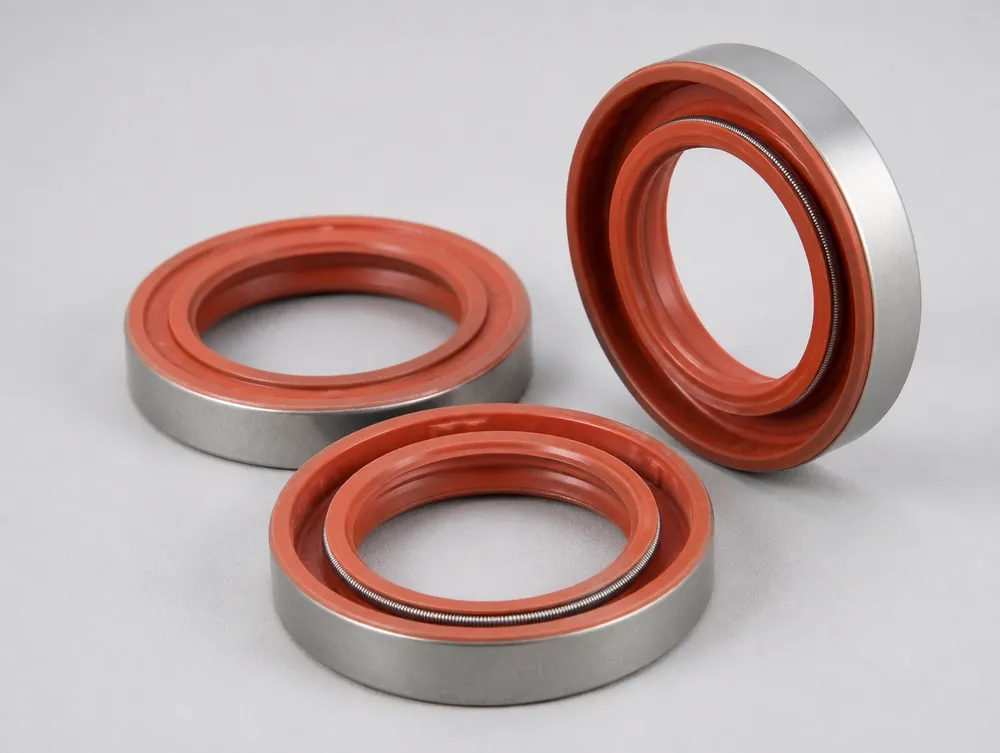
Rubber rotary shaft seals that hold lubricating oil inside the compressor housing and keep dust, moisture and grit away from the bearing area. Supplied in NBR, FKM and silicone, in sizes matched to your shaft, bore and seal width — share your dimensions and our team will help identify a suitable seal.
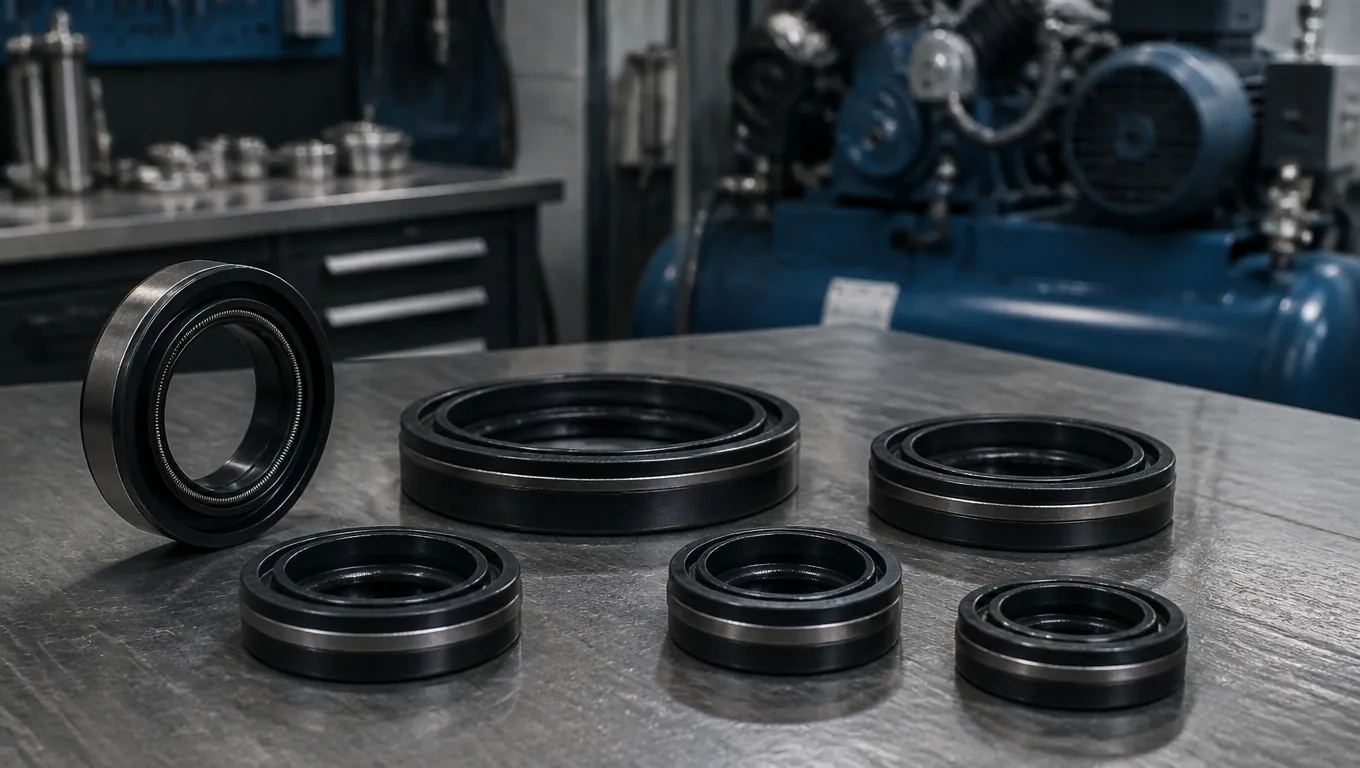 Illustrative product view
Product overview
Compressor oil seals are rotary shaft seals fitted at the point where a shaft passes through an oil-filled compressor housing. Each seal combines an elastomeric sealing lip, a metal or reinforced outer case and, in most designs, a garter spring that keeps the lip in light, even contact with the rotating shaft.
Their primary purpose is to retain lubricating oil in the crankcase or bearing housing while the shaft turns. At the same time they limit the entry of dust, moisture and airborne grit into the sealing area, which helps protect the bearing, the shaft surface and the oil itself. On a compressor the seal often works close to a pulley, coupling or drive end, so it also keeps oil away from parts that should stay dry.
Compressor duty is not the same as general machinery duty. Crankcase pressure pulses, oil mist, continuous running and, on some machines, high shaft speeds all place demands on the lip. That is why dimensions alone are not enough: material, lip design and shaft condition have to match the machine.
Ananta Venture is a Delhi-based manufacturer of rubber oil seals and V belts for industrial and machinery applications. Compressor oil seals are supplied to requirement, with guidance on dimensions, material options and lip configuration before you place an order.
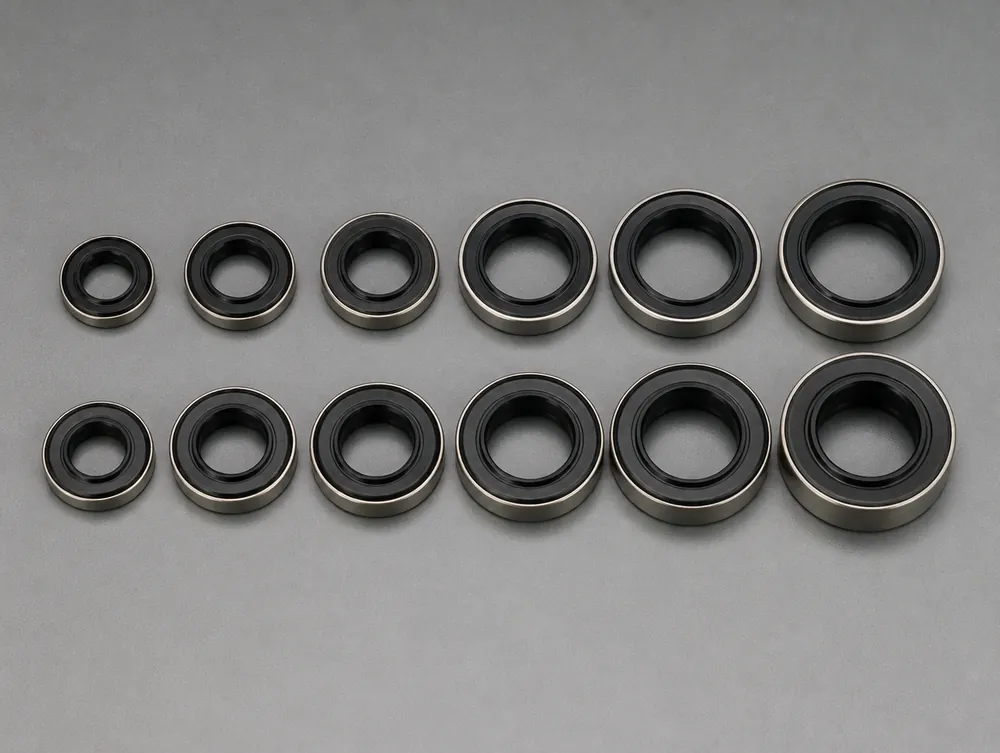
Functions & benefits
A compressor oil seal is a small, low-cost component with a direct effect on how cleanly and reliably the machine runs. These are the jobs it performs, and why each one matters on a working unit.
The lip closes the gap around the rotating shaft so lubricant stays in the housing rather than escaping onto the pulley, coupling, belt or floor. A dry machine is easier and safer to maintain.
Bearings and moving parts depend on a steady oil supply. Keeping the oil level and oil film intact helps prevent starved running, overheating and the wear that follows.
Dust, water and grit are kept away from the lip and bearing chamber. Less contamination means less abrasive wear on the shaft, the seal and the bearing surfaces behind it.
The seal takes the rubbing wear instead of the shaft, and keeps abrasive particles out of the bearing. Replacing a seal is far simpler than re grinding a shaft or rebuilding a bearing housing.
A seal that is correctly selected and fitted supports steady operation between service intervals. It reduces the chance of oil loss, contamination damage and the unplanned stops that follow.
Seals are consumable parts. Knowing the size, material and installation method in advance makes planned replacement quicker and avoids improvising a seal during a breakdown.
Seal performance depends on shaft condition, housing bore, alignment, lubricant, temperature, pressure and installation. A suitable seal, correctly fitted to a healthy shaft, gives the best chance of long service — but service life cannot be guaranteed for a given machine.
Seal configurations
Different compressor shafts and housings call for different seal constructions. The categories below explain what each configuration is normally used for; the final choice depends on shaft speed, housing pressure, temperature, lubrication and how the compressor is built.
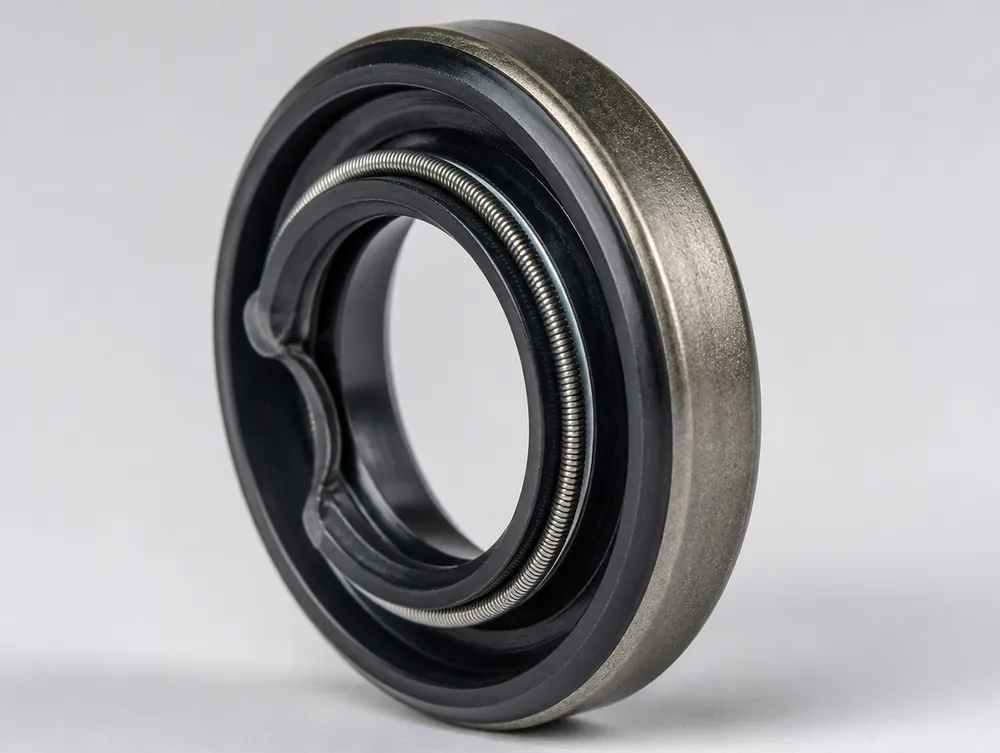
The most common construction: one moulded sealing lip runs against the shaft and retains lubricant, with a garter spring applying light, uniform pressure. It suits clean, well-protected housings where the main requirement is oil retention.
Where dust or water spray reaches the shaft, a single lip may not provide enough exclusion on its own, and a secondary lip or shield should be considered.
A double-lip seal adds a secondary lip, usually facing outward, alongside the main sealing lip. The main lip holds oil in; the second lip acts as a dust or exclusion edge and can give extra protection in dirty or damp conditions.
The extra lip increases friction and may need lubrication of its own, so it is not automatically better for every compressor. Speed and housing design still decide.
A garter spring sits behind the lip and keeps it in contact with the shaft as the elastomer relaxes or wears. Spring-loaded lips are typical of rotary shaft seals and help maintain sealing force over a longer period.
Spring type, tension and material must suit the shaft and lubricant. A displaced or corroded spring is a common cause of leakage after a poor installation.
Here the elastomer extends over the outside of the seal as well as the lip. The rubber outside diameter can accommodate minor bore imperfections and provides a slight interference fit in the housing, which helps sealing against the bore.
Rubber-covered seals are widely used in split or machined housings and where the bore surface is less than perfect. Housing finish and fit still matter.
The outer case is metal, giving a rigid body that presses into the housing bore and holds its shape under load. Metal-cased seals are common where the housing is machined to a defined bore and a firm, square fit is required.
Because the metal case is exposed, bore finish, chamfer and installation force need attention. A distorted case can leak at its outer diameter even if the lip is healthy.
Where the shaft, bore or housing depth falls outside standard sizes, or the duty calls for a particular lip and material combination, a custom requirement can be reviewed against your measurements and drawing.
Send the shaft and bore dimensions, seal width, lubricant, temperature, speed and quantity — plus a sample or drawing of the existing seal where available.
A seal that works well on a slow reciprocating compressor may not suit a high-speed screw compressor, and a design used on one housing may not fit another. Shaft speed, pressure, temperature, lubrication and equipment construction decide which construction is appropriate.
Material selection
NBR, FKM and silicone cover many compressor sealing duties, but they behave differently with oil, heat and abrasion. The right compound is decided by the lubricant, the temperature at the seal, the shaft speed and the environment around the machine.
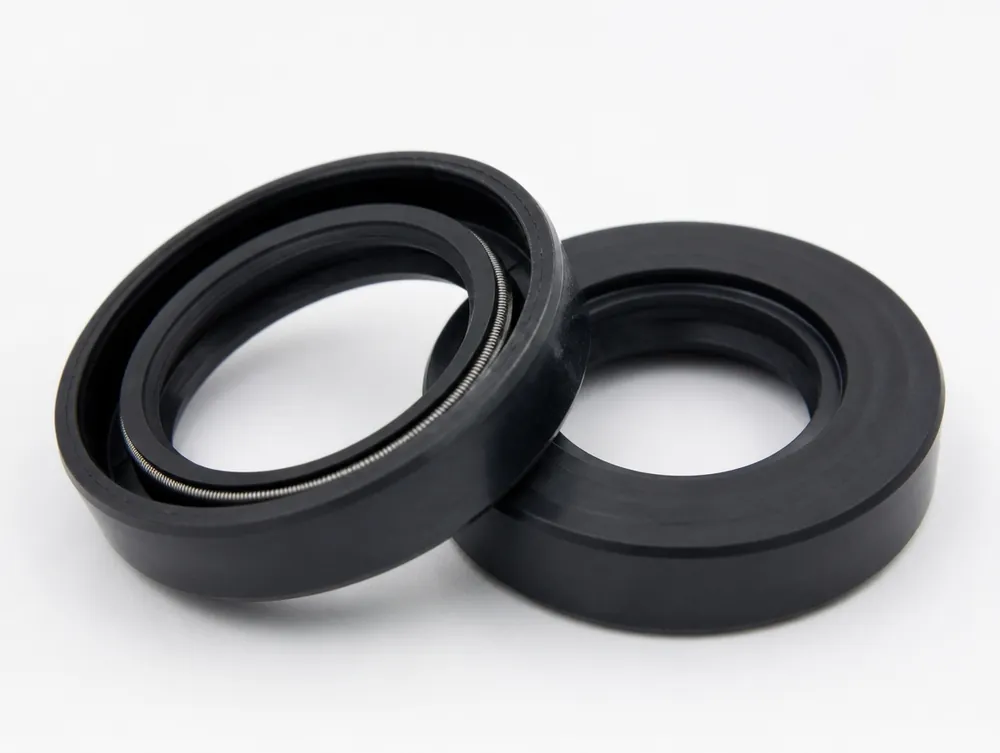
Nitrile butadiene rubber
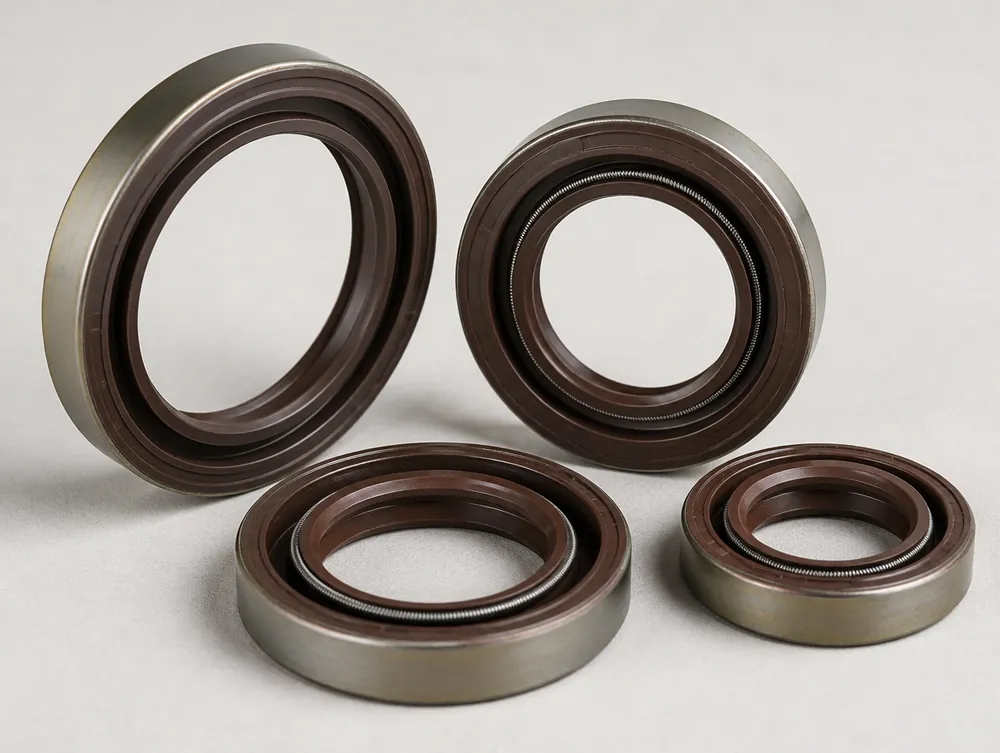
Fluorocarbon rubber (Viton® type)
Silicone elastomer
Actual temperature capability, swell and chemical resistance depend on the compound formulation, the lubricant, the temperature at the seal, shaft conditions and pressure. No universal temperature limit applies to “NBR” or “FKM” as a category. The compound datasheet and the compressor manufacturer's specification should be the reference for a specific application.
Where they are used
Oil seals appear wherever a compressor shaft leaves an oil-filled housing. The categories below describe typical compressor oil seal applications; each one places different demands on the seal, and the design is confirmed against the actual machine.
Seal crankcase and bearing housing shafts on general-purpose air compressors used in workshops, plants and utility areas.
Continuous running and oil mist make lip material and shaft condition the main selection points.
Seal bearing housing and shaft extensions on screw compressor units, where rotor speed and oil circulation are high.
Speed, oil flow and heat generation around the bearing area should be reviewed with the seal supplier.
Seal the crankshaft where it leaves the crankcase, close to the flywheel, pulley or coupling.
Crankcase pressure pulsation and shaft deflection are relevant, so the seal must suit the housing and breather arrangement.
Retain oil at the crankshaft bearing housing on single and multi-cylinder piston compressors.
Belt-driven units often expose the seal to dust from the drive area, which can justify a dust lip.
Support the compressors, dryers and auxiliaries within a compressed-air installation where shaft sealing keeps oil where it belongs.
Ambient conditions, wash-down and air quality requirements influence the material and lip choice.
Seal shaft extensions on compressor rebuilds, replacement assemblies and OEM builds where a defined shaft and bore are available.
Dimensions and bore condition should be recorded during assembly so a replacement can be matched later.
Working principle
In an air compressor, the oil seal sits between the rotating shaft and the housing that contains the lubricant. The sealing lip is pressed lightly against the shaft by its own moulded shape and by the garter spring behind it. As the shaft turns, a thin oil film is carried under the lip, which lubricates the contact and helps the lip seal without running dry.
The lip is directional in practice: its angle and contact pressure are designed to push oil back towards the housing while resisting the movement of contaminants in the other direction. That is why fitting a seal the wrong way round, or damaging the lip during installation, causes leakage even when the size is correct.
Compressor housings are not always at atmospheric pressure. Crankcase pressure, oil mist and the position of the breather affect the pressure difference across the seal. A seal is not a pressure-retaining device by itself; if housing pressure is excessive, the cause should be corrected rather than relying on the seal to hold it.
Installation matters as much as the part. A clean bore, an undamaged lip, correct alignment and a suitable fitting tool decide whether a good seal performs as intended. Details are covered in the compressor shaft oil seals section below.
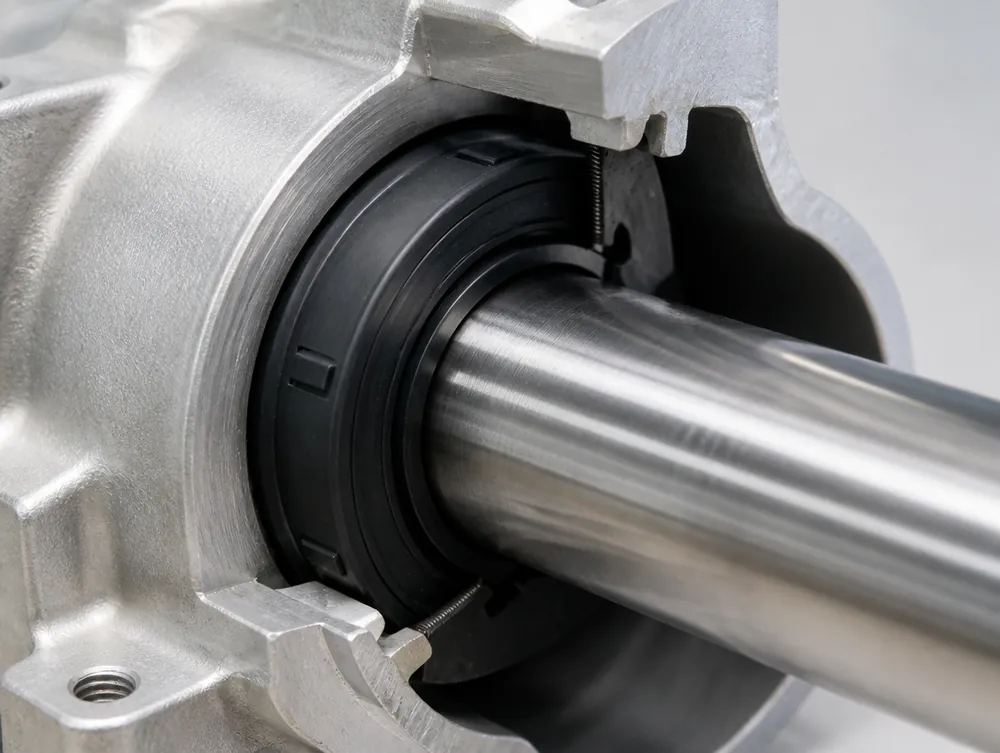
Shaft sealing detail
The shaft is half of the sealing system. A seal can only perform as well as the surface it runs on, so shaft condition is checked alongside the seal dimensions whenever a replacement is selected.
The sealing lip touches the shaft along a narrow band. Contact pressure comes from the lip geometry and the garter spring, and is intended to be just enough to control the oil film. Too little pressure allows oil past; too much generates heat and wears the lip and shaft.
Because the contact is dynamic, the lip needs lubrication. A dry start, a starved bearing or the wrong oil can shorten seal life even if the compound is correct. The shaft surface also needs to be smooth enough to let the lip bed in without tearing, but not so polished that the oil film cannot form.
Before ordering, inspect the shaft at the exact position where the lip will run — not a neighbouring unworn section.
| Shaft factor | Why it matters | What to check |
|---|---|---|
| Surface finish | Too rough, and the lip wears quickly; too smooth, and the oil film may not form reliably. | Look for turning marks, polishing or scoring at the lip track. Compare with the equipment specification. |
| Wear groove | A groove left by the old lip can prevent a new seal from contacting correctly. | Run a fingernail across the track. A noticeable step may call for a repair sleeve or shaft replacement. |
| Shaft runout | Eccentric movement forces the lip to flex on every revolution, which can cause uneven wear and leakage. | Check with a dial indicator where the equipment data allows, and inspect bearing condition. |
| Alignment | A seal pressed in at an angle contacts the shaft unevenly and may leak at one side. | Fit square to the bore using a proper driver; check that the seal sits fully and evenly in the housing. |
| Lubrication at the lip | The lip needs an oil film during running and a compatible lubricant during assembly. | Apply the specified oil to the lip and shaft before fitting; never fit a seal dry unless the design requires it. |
| Shaft hardness and material | A soft or worn shaft wears faster under the lip; some repaired surfaces may not suit a lip seal. | Confirm the shaft material and any repair history with the maintenance record or machine builder. |
On a narrow screen, scroll the table sideways to read all three columns.
Non-standard requirements
When a standard size does not match the shaft, housing or duty, a custom requirement can be discussed. The clearer the specification, the faster a suitable configuration can be identified.
Custom requirements usually involve one or more of the following: a shaft or bore outside standard ranges, a specific elastomer for the lubricant in use, a particular lip arrangement for dusty or wet conditions, or a seal width fixed by the housing depth.
Customisation is not only about dimensions. Material grade, lip geometry, spring type and outer case style all influence how the seal behaves at speed and temperature, so describe them together rather than one at a time. Where an original seal is available, a sample or clear photograph of its cross-section is often more useful than a list of numbers alone.
Compressor oil seals are usually described as inner diameter × outer diameter × width. Always state the unit and measure the actual component; this format is an example, not a stock specification.
Gather this information before you contact us. It reduces back-and-forth and makes the requirement easier to review.
Buyer's guide
Work through these points in order. Most sealing problems trace back to one of them — a dimension taken from the wrong surface, a lubricant the compound does not suit, or a shaft that is too rough for the lip.
Establish whether the unit is reciprocating, piston, rotary screw or another type, and where the seal sits on the shaft.
Measure the shaft diameter at the sealing position, along with the housing bore and the seal width.
Confirm the shaft speed or surface speed at the lip. Higher speeds need a suitable lip design and heat control.
Use the temperature at the seal, including start-up, peak and continuous conditions, to narrow the material choice.
Identify the oil grade, base stock and additives. The compound must be compatible with the oil actually in the machine.
Note crankcase pressure, breather arrangement and any pressure difference across the seal.
Check the elastomer against the lubricant, cleaning agents and any process contamination the seal will meet.
Consider dust, moisture, wash-down, ambient heat and access for fitting the seal squarely.
Where a part number, drawing or sample exists, use it. Manufacturer data overrides assumptions from the compressor model.
Variants of the same compressor model can use different shafts, housings and bearing arrangements. Measure the shaft, bore and width, or use the equipment manufacturer's part data, before ordering.
Send the shaft diameter, bore, seal width, lubricant and operating temperature. Our team will review the requirement and help you identify a suitable compressor oil seal.
Maintenance
Seal wear usually shows itself gradually. These are the signs worth acting on, along with the checks that should be made before a new seal is fitted.
Fresh oil around the shaft, housing or drive end, or oil mist collecting dust on nearby parts. Confirm whether the source is the seal, a joint, a breather or a bearing housing.
A cut, torn, folded or flattened lip visible after removal. Installation damage, a sharp shaft edge or a keyway can all cause this.
A lip that has lost its flexibility, feels brittle or shows surface cracks. Heat ageing and the wrong lubricant are common contributors.
A widened contact band, material loss at the lip or a worn spring. Wear this pronounced usually points to shaft finish, contamination or running conditions.
Mud, grit, metal particles or moisture packed around the lip. The seal may still be intact while the cause of the problem lies elsewhere.
The same position leaking again soon after replacement. This usually means the shaft, bore, alignment, pressure or lubricant needs investigation, not just another seal.
Oil at the shaft does not automatically mean the seal has failed. Overfilling, a blocked breather, high crankcase pressure, bearing play, a worn shaft or the wrong oil can all produce the same symptom. Inspect the assembly before replacing the seal, so the new part is not exposed to the same cause.
Working with us
Ananta Venture is a Delhi-based manufacturer of rubber oil seals and V belts for industrial, automotive, agricultural and heavy machinery applications. The support around compressor oil seals is practical and specification-led.
Share the shaft, bore and width with the compressor application, and we will help you read the requirement against the seal formats we work with.
Tell us the lubricant and the temperature the seal will see, and we will help narrow the choice between NBR, FKM, silicone and other options.
Seals for plant maintenance, machinery builders, workshops and trade buyers, supplied from our Burari, Delhi base.
Non-standard sizes, specific materials and particular lip arrangements can be discussed against your measurements and duty.
Quantity requirements can be shared directly by phone, WhatsApp or the contact page, along with the sizes and material needed.
Reach the team on +91 9211305366 from West Sant Nagar, Burari, Delhi — no call centre between you and the requirement.
Common questions
Short answers to the questions buyers ask most often about compressor oil seals, their materials and how to specify them.
Compressor oil seals are rotary shaft seals fitted where a shaft leaves an oil-filled compressor housing. A rubber lip runs against the rotating shaft, retains lubricating oil inside the housing and helps keep dust, water and other contamination out of the bearing and crankcase area.
In an air compressor the oil seal closes the gap between the rotating shaft and the housing. It holds oil in the crankcase or bearing housing, limits the entry of dirt and moisture, and protects the bearing and shaft surface from contamination and lubricant loss.
NBR (nitrile rubber), FKM (fluoroelastomer) and VMQ (silicone rubber) are the materials most often discussed, along with other application-specific compounds. The choice depends on the lubricant, operating temperature, shaft speed, pressure and the environment around the seal, and should be confirmed against the compound data and the equipment manufacturer's specification.
A single-lip seal has one main sealing lip that retains lubricant. A double-lip seal adds a secondary lip, usually facing outward, which can act as a dust or exclusion lip and provide extra protection in dirty or wet conditions. The extra lip adds friction, so the design must suit the shaft speed and lubrication of the compressor.
Measure the shaft diameter at the sealing position, the housing bore diameter and the seal width, then check the shaft speed, operating temperature, lubricant and shaft surface condition. Use the equipment manufacturer's part data where it is available, and confirm the dimensions on the actual component rather than estimating them from the compressor model.
Non-standard dimensions, specific materials and particular lip arrangements can be discussed. Share the shaft and bore measurements, seal width, material requirement, operating conditions, equipment model and quantity, and include a drawing or sample of the existing seal where possible.
Leakage can come from a worn or hardened sealing lip, a worn or grooved shaft, excessive shaft runout or misalignment, damaged installation, the wrong lubricant or material, contamination at the lip, or pressure build-up in the housing. Because several causes produce the same symptom, the assembly should be inspected before a replacement seal is fitted.
Inspection is normally tied to the compressor manufacturer's maintenance schedule and to routine service checks such as oil changes. Seals on machines working in dusty, hot or high-hour conditions may need closer attention. Any visible oil film, oil consumption or contamination around the shaft should be checked promptly rather than waiting for the next scheduled service.
Oil seals are used on many compressor types, including reciprocating, piston, rotary screw and other industrial air compressors. Shaft speed, housing pressure, lubricant, temperature and bearing arrangement differ between machines, so the seal design and material must be selected for the specific compressor rather than assumed to suit every unit.
Provide the inner diameter, outer diameter and width, the measured shaft and bore dimensions, the required material, operating temperature, shaft speed, lubricant type, the compressor model or application and the quantity needed. A sample, drawing or clear photograph of the existing seal helps confirm the requirement.
Next step
Send your shaft diameter, housing bore, seal width, lubricant and operating temperature, along with the compressor model and quantity. Our team will review the requirement and help you identify a suitable compressor oil seal.
Prefer to speak? Call +91 9211305366. Please share dimensions and quantity so the requirement can be reviewed properly.