Hydraulic piston seals
Seal the gap between the piston and the cylinder bore, separating the two chambers of a cylinder so pressure can build on the working side.

Hydraulic sealing components
Hydraulic oil seals retain pressurised fluid inside pumps, cylinders and valve bodies, and help keep dust, water and metal particles out of the system. The right seal is a combination of profile, material and exact dimensions — not simply the closest size available.
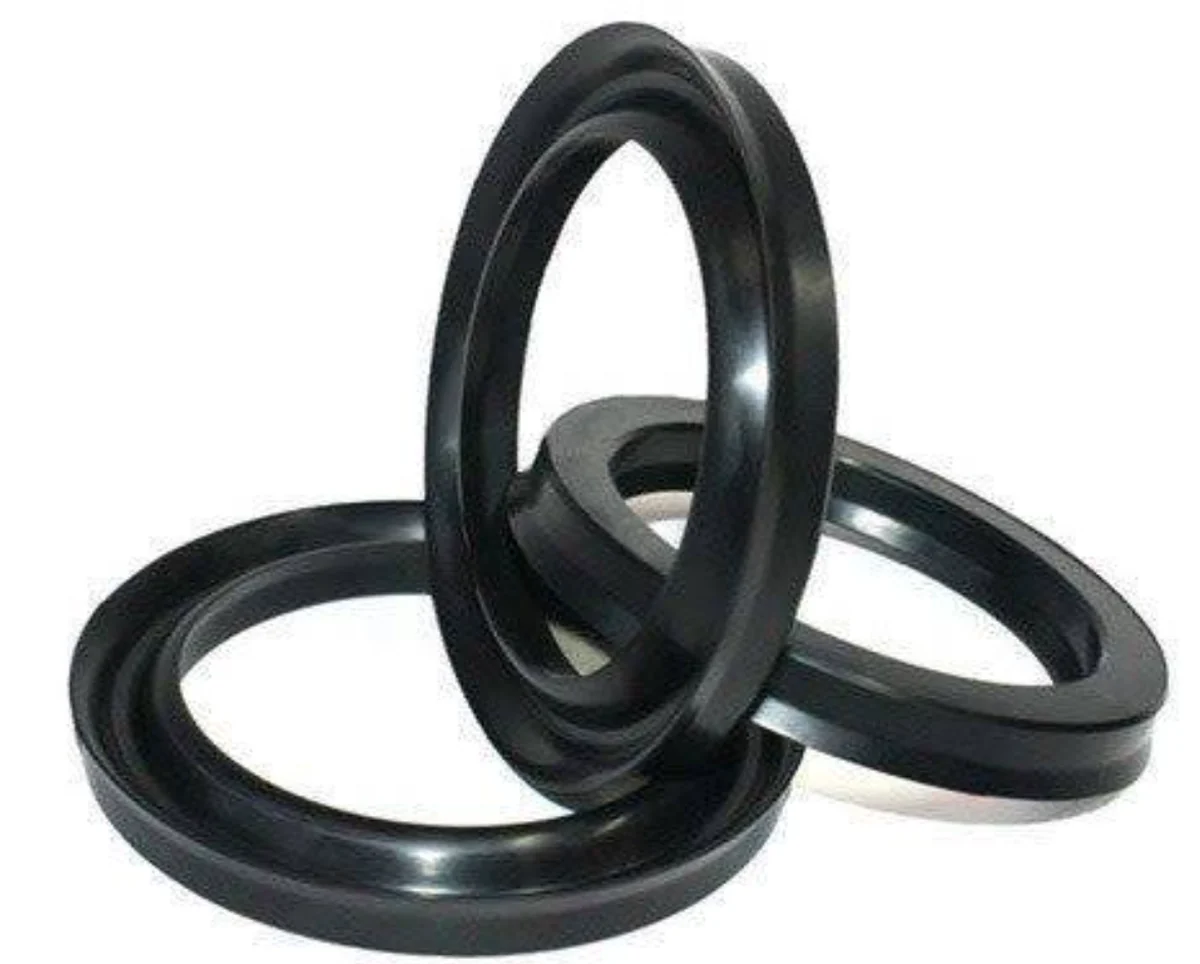
Piston and rod seal profiles from our oil seal range.
01 — Introduction
Hydraulic oil seals are ring-shaped components that close the gap between two parts of a hydraulic assembly. Most sit in a machined groove or housing and press lightly against a mating surface, forming a barrier that holds oil under pressure while the machine works.
Hydraulic systems are designed around controlled pressure. Fluid that escapes past a rod, piston or joint reduces the force the system can deliver, lowers efficiency and eventually shows up as oil on the floor. Sealing is therefore a functional part of the design, not an accessory: the seal profile controls how the lip responds to pressure, and the material controls how long that response survives heat, abrasion and contact with the fluid.
A hydraulic oil seal is not one universal part. A cylinder may use a piston seal, a rod seal, a wiper and one or more static seals, each performing a different job at a different point in the assembly. Rotary shaft seals at a pump input shaft add a further distinction, because the shaft rotates rather than reciprocates.
A hydraulic oil seal is a sealing element that retains hydraulic fluid between two components of a hydraulic system — such as a piston and bore, a rod and gland, or two static faces — and, where the design includes a dust lip or wiper, helps exclude external contamination.
Used where the two surfaces do not move relative to each other: flange faces, port fittings, end caps and valve bodies. O-rings and moulded seals are common, and selection is driven mainly by fluid, temperature and groove dimensions.
Used where a surface slides or rotates. Piston and rod seals are reciprocating; shaft seals are rotary. Dynamic seals must seal while wearing, so lip geometry, surface finish and lubrication matter as much as the compound.
Illustration only. Actual seal positions, groove details and profiles vary by cylinder or pump design and must be confirmed against the equipment drawing or sample.
02 — Function
Seals do more than stop visible leaks. They hold the pressure boundary together at every point where a hydraulic component opens to the atmosphere or splits into two chambers.
The primary duty. A correctly matched seal restricts flow across the gap between two parts — for example between the piston and cylinder bore, or between the rod and gland.
Because hydraulic force depends on trapped fluid, seal integrity directly affects how much load a cylinder can hold and how consistently a pump delivers flow.
Wipers and dust lips scrape dust, mud and metal particles from a rod before they reach the sealing lip. This protection is only effective when the wiper itself is in good condition.
Worn piston seals can allow internal bypass, causing drift, slow response or heat build-up. Restoring the seal often restores the machine's original behaviour.
Leakage and contamination are common reasons for unscheduled downtime. Selecting and installing the right seal helps reduce repeat work — though no seal can be guaranteed to last a fixed number of hours.
By keeping abrasive particles out of the oil, seals help protect pumps, valves and bearings from the wear that contaminated fluid accelerates.
Seal performance depends on the complete assembly: groove dimensions, surface finish, alignment, fluid cleanliness and operating cycle all influence how long a seal remains effective. Zero leakage is not a realistic promise for a dynamic seal.
03 — Seal types
Each position in a hydraulic assembly calls for a different seal. Piston seals and rod seals are often confused because they look similar in a parts box, but they face different pressures, different surfaces and different contamination. They are not interchangeable.
A piston seal works against a bore with the pressure acting from one or both sides, depending on whether the cylinder is single- or double-acting. A rod seal works around a hard chrome rod, with pressure normally acting from one side only, and is usually paired with a wiper at the gland face.
The list below covers the seal families most often specified for hydraulic cylinders, pumps and industrial hydraulic equipment. Exact profiles, groove sizes and material grades are confirmed against the application — the descriptions here are a starting point for identification, not a catalogue of stock items.
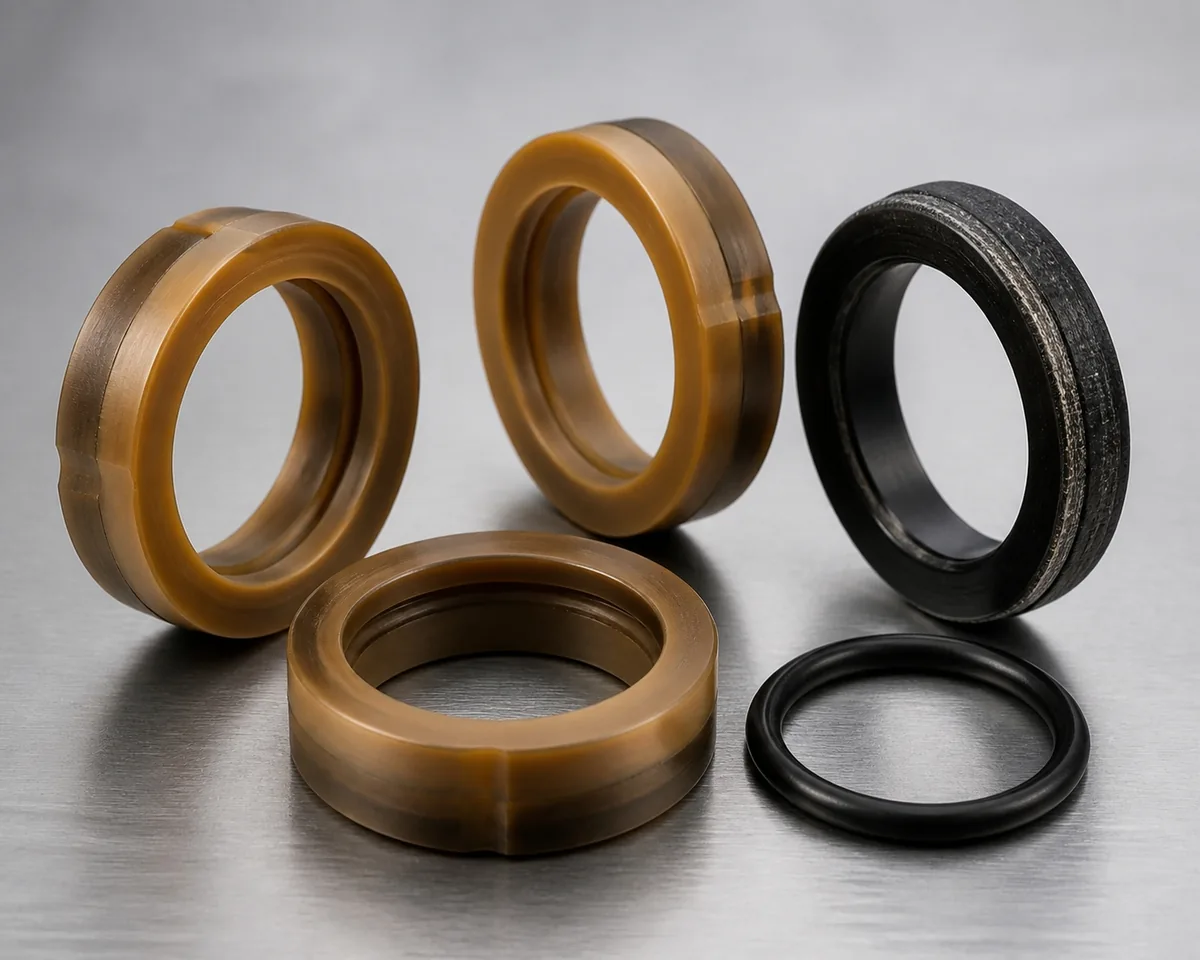
Seal the gap between the piston and the cylinder bore, separating the two chambers of a cylinder so pressure can build on the working side.
Seal around the rod where it leaves the cylinder, retaining pressurised oil in the gland while allowing the rod to stroke in and out.
Scrape dust, mud, ice and metal particles off the rod on the retract stroke so contamination does not reach the rod seal or the oil.
Support an O-ring or soft seal on the low-pressure side to reduce the risk of the seal extruding into the clearance under pressure.
Seal the drive shaft where it enters the pump housing, keeping oil in and air and dirt out of the pump case.
Seal joints that do not move: end caps, flanges, port connections, valve blocks and threaded plugs. Often the simplest seal on the machine, and often overlooked.
Reciprocating seals are not rotary shaft seals. A hydraulic piston or rod seal is designed for linear movement and pressure loading; a rotary shaft oil seal is designed for continuous rotation with a garter spring and a different lip geometry. The two are sometimes both called “oil seals”, but a rotary seal should not be substituted into a reciprocating groove, or the reverse.
04 — Material focus
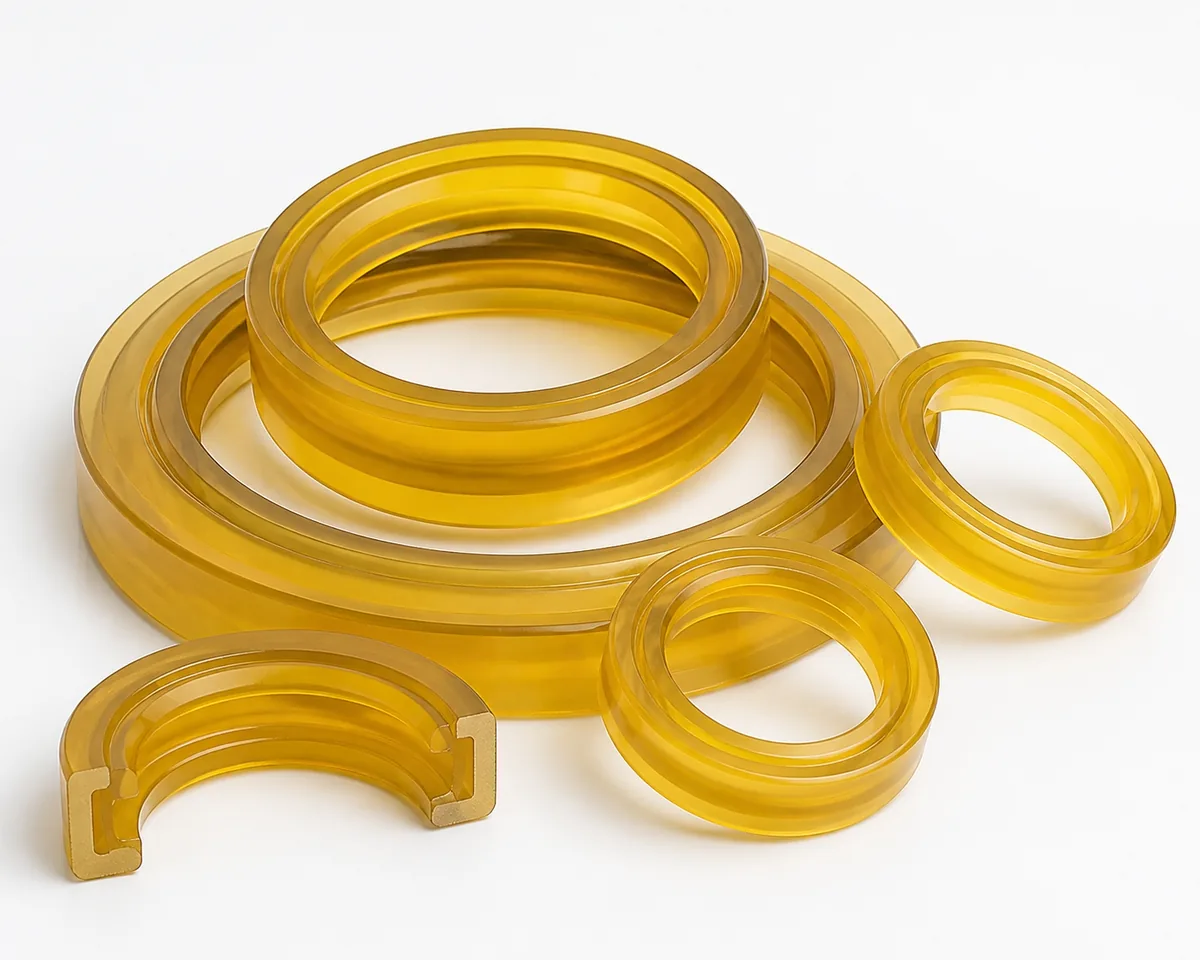
Polyurethane (PU) is one of the most common materials for hydraulic piston, rod and wiper seals. It combines a hard-wearing surface with enough elasticity to follow the mating surface, which suits the sliding duty inside a cylinder.
The properties buyers usually value are abrasion resistance, tear strength and resistance to extrusion when the profile and clearance allow it. Those properties make PU a practical choice for equipment that works in dust, mud or high-cycle duty, where a softer rubber lip might wear more quickly.
Suitability is not automatic. PU is a family of materials rather than a single compound: cast and thermoplastic grades differ in hardness, compression set and fluid resistance, and some grades are affected by water-based fluids, steam or particular additives. Temperature, pressure, surface finish and groove design all change the outcome. The grade and profile have to be confirmed against the application, not chosen by colour or by the word “PU” alone.
For oil seals outside hydraulic duty, see the wider range of PU oil seals.
05 — Materials
Material choice follows the fluid first, then temperature and pressure. A compound that performs well in mineral oil may fail quickly in a water-glycol or phosphate-ester system, and the reverse is equally true.
| Material | Typical hydraulic use | Notes and limits |
|---|---|---|
| Polyurethane (PU) | Piston, rod and wiper seals in cylinders and mobile equipment | Abrasion and tear resistant with good extrusion resistance in suitable profiles. Temperature and fluid limits depend on the grade; some grades are unsuitable for water-based fluids or certain additives. |
| Nitrile rubber (NBR) | General hydraulic O-rings, static seals and rotary shaft seals | Good resistance to mineral oils and greases at moderate temperatures. Not suitable for many phosphate esters, ketones, strong acids or ozone-rich outdoor duty without protection. |
| Fluoroelastomer (FKM / FPM) | Higher-temperature seals and aggressive-fluid duties | Broad chemical and thermal resistance, at higher cost. Generally not recommended for hot water, steam or low-temperature service; confirm the specific grade. |
| EPDM | Glycol, water-based and brake-fluid systems; some steam duty | Excellent resistance to water, glycol and many water-based fluids — but generally unsuitable for petroleum-based hydraulic oils and mineral oils. |
| PTFE | Backup rings, guide rings and low-friction sealing elements | Chemically inert with low friction, but low elasticity. Normally used with an energiser or in a defined backup or guide role rather than as a standalone soft lip. |
| Fabric-reinforced / POM | Wear rings, guide rings and anti-extrusion components | High load capacity and dimensional stability. These are bearing and support elements, not sealing lips; they protect the seal and guide the piston. |
EPDM is not a general-purpose hydraulic seal material. It is generally unsuitable for conventional petroleum-based hydraulic oils, where it can swell and lose strength. It is used where the fluid is compatible — typically glycol, water-based fluids, brake fluid or steam — and that compatibility must be confirmed against the fluid supplier's data.
Fluid type and temperature narrow the field first; pressure and clearance then decide whether a reinforced or anti-extrusion design is needed; movement (static, reciprocating or rotary) decides the profile family. Groove dimensions and surface finish confirm whether the chosen section will actually fit and seal.
A high-grade compound in the wrong groove, with poor surface finish or a damaged lip during fitting, may perform worse than a standard seal installed correctly. Material, profile, dimensions and installation all have to be right at the same time.
06 — Applications
Hydraulic sealing requirements appear wherever fluid pressure produces force or motion. The application areas below are typical starting points — the correct seal configuration still depends on the individual equipment and its duty cycle.
Piston, rod, wiper and static seals in single- and double-acting cylinders.
Shaft seals, seals between sections and static seals on ports and covers.
Power packs, valve manifolds, accumulators and pipeline joints.
Excavator, loader and backhoe cylinders exposed to dust, shock and weather.
Tractor hydraulics, harvesting and tillage equipment working in abrasive soil.
Conveyors, lifts, clamping and positioning equipment in production lines.
Press rams and holding cylinders where pressure is high and cycle counts are long.
Steering, braking, marine and specialised machinery sealing arrangements.
A listed application does not confirm that a particular seal style, size or material is suitable for every machine in that category. Confirm against the equipment manufacturer's specification, the existing seal or the housing dimensions.
07 — Heavy-duty service
Heavy equipment compresses more wear into a single shift than most industrial systems do in a week. Seals on an excavator or loader face pressure spikes, impact, grit and temperature swings — often at the same time, on a machine that cannot afford to stand still.
That is why the specification for a heavy-duty seal is not just a size. The profile has to resist extrusion at peak pressure, the compound has to survive abrasion without crumbling, and the wiper has to keep the rod clean enough for the rod seal to do its job.
A cheaper seal that fails early takes the machine out of service, adds labour and oil, and may damage the rod or bore. For heavy machinery, the cost of one breakdown usually exceeds the price difference across a full seal kit.
The practical comparison is total cost over the service interval: seal price, fitting time, downtime and the risk of secondary damage. That comparison only works when the seal is matched to the actual pressure, temperature, fluid and surface conditions of the machine.
Confirm the machine model and serial number, the cylinder or pump reference, the rod or bore diameter, and whether the seal is original or already a replacement. A photo of the worn seal in its groove is often more useful than a photo of the seal alone.
08 — Selection guide
Work through these points in order. Each one can eliminate a seal that looks correct but will not perform in service.
Before placing an order, confirm dimensions, material and operating specification in writing. A seal matched only by outside diameter can be wrong in section, lip geometry and compound.
09 — Manufacturing and supply
Ananta Venture is a Delhi-based manufacturer of oil seals and V belts, supplying industrial, automotive, agricultural and heavy machinery customers across Delhi NCR and the rest of India. For hydraulic seals, the starting point is the application rather than a stock number: the seal position, dimensions and operating conditions determine which construction can be offered.
Buyers comparing hydraulic oil seal manufacturers or suppliers usually need four things confirmed before an order: the exact dimensions and profile, the material and grade, the operating limits the seal is intended for, and the delivery commitment. Those details are best settled in writing against a drawing, sample or clear measurement record.
Where a standard construction matches the requirement, that is normally the quickest route. Where it does not, the request becomes a custom or made-to-specification enquiry, which needs design review before availability can be confirmed.
Manufacturing scope, stock availability and lead times vary by seal construction. Confirm current capability, minimum quantities and delivery for your specific requirement with the sales team before committing to a schedule.
10 — Custom seals
Customisation is usually about fit, not novelty. If no standard seal matches the groove, the rod or the duty, a made-to-specification seal may be the practical option — provided the design and dimensions can be agreed first.
Older or imported equipment often uses sizes outside common ranges. Accurate measurement of the housing, rod or bore is essential, because the seal is built to those dimensions rather than selected from a table.
Combined rod seal and wiper elements, asymmetric lips or compact grooves may need a profile that is not held as a standard. A drawing or a sectioned sample is normally required to review the design.
Aggressive fluids, high temperature or abrasive duty may require a specific compound or hardness. The fluid data sheet and operating conditions should accompany the request.
Where the old seal is available, its markings, section and lip condition help identify the original specification. A worn seal should be measured with care, since dimensions change in service.
A dimensioned drawing with tolerances, material and surface requirements gives the clearest basis for quotation and production, and reduces the risk of a mismatch on delivery.
Some assemblies need a seal that works with a specific gland, wear ring or backup arrangement. Sharing the equipment make, model and assembly details helps confirm what will fit.
Custom availability has to be confirmed. Not every profile, material or dimension can be produced economically, and tooling or minimum order quantities may apply. Send the drawing, dimensions and operating conditions for review; availability is confirmed only after that review.
11 — Working with us
A seal enquiry is easier when the supplier asks the right questions. Our approach is to match the seal to the application and confirm the details before dispatch.
Enquiries can be placed on dimensions, a sample, an OEM part number or a drawing — so the discussion starts from the application, not from the nearest available size.
Questions about profile, material or fit can be discussed by phone or WhatsApp with the sales team, rather than through a form queue.
Oil seals and V belts are both part of the Ananta Venture range, which can simplify sourcing for maintenance and OEM buyers.
Based in Burari, Delhi, and supplying customers across Delhi NCR and the rest of India, with dispatch details confirmed at the time of order.
No certifications, production capacity figures or performance guarantees are stated on this page. Any such detail should be requested directly and confirmed in writing for your requirement.
12 — Buying information
A complete enquiry usually gets a faster and more accurate answer. The table below lists what helps identify the right seal — send as much of it as you have, and the team can confirm what is still needed.
| Information | Why it matters |
|---|---|
| Seal type and position | Piston, rod, wiper, shaft or static — the position determines the profile family and how pressure acts on the lip. |
| Inside and outside diameter | Where applicable, these define the sealing and housing surfaces. Measure the housing and the rod or bore, not only the worn seal. |
| Cross-section or height | The groove width and depth must accept the seal section; an incorrect height prevents correct seating and retention. |
| Material specification | Fluid compatibility and temperature decide the compound. State the material if known, or the fluid and conditions if not. |
| Operating pressure | Working and peak pressure indicate whether a backup ring or reinforced profile is needed. |
| Operating temperature | Start-up and running temperatures, including any heat soak, narrow the material choice. |
| Hydraulic fluid type | Mineral, water-based, phosphate ester or biodegradable fluids are not interchangeable in sealing terms. |
| Quantity | Order quantity affects packing, price breaks and, for non-standard items, minimum production quantities. |
| Drawing, photo, OEM number or sample | Any of these removes ambiguity about profile and dimensions. A clear photo of the seal in its groove is often most useful. |
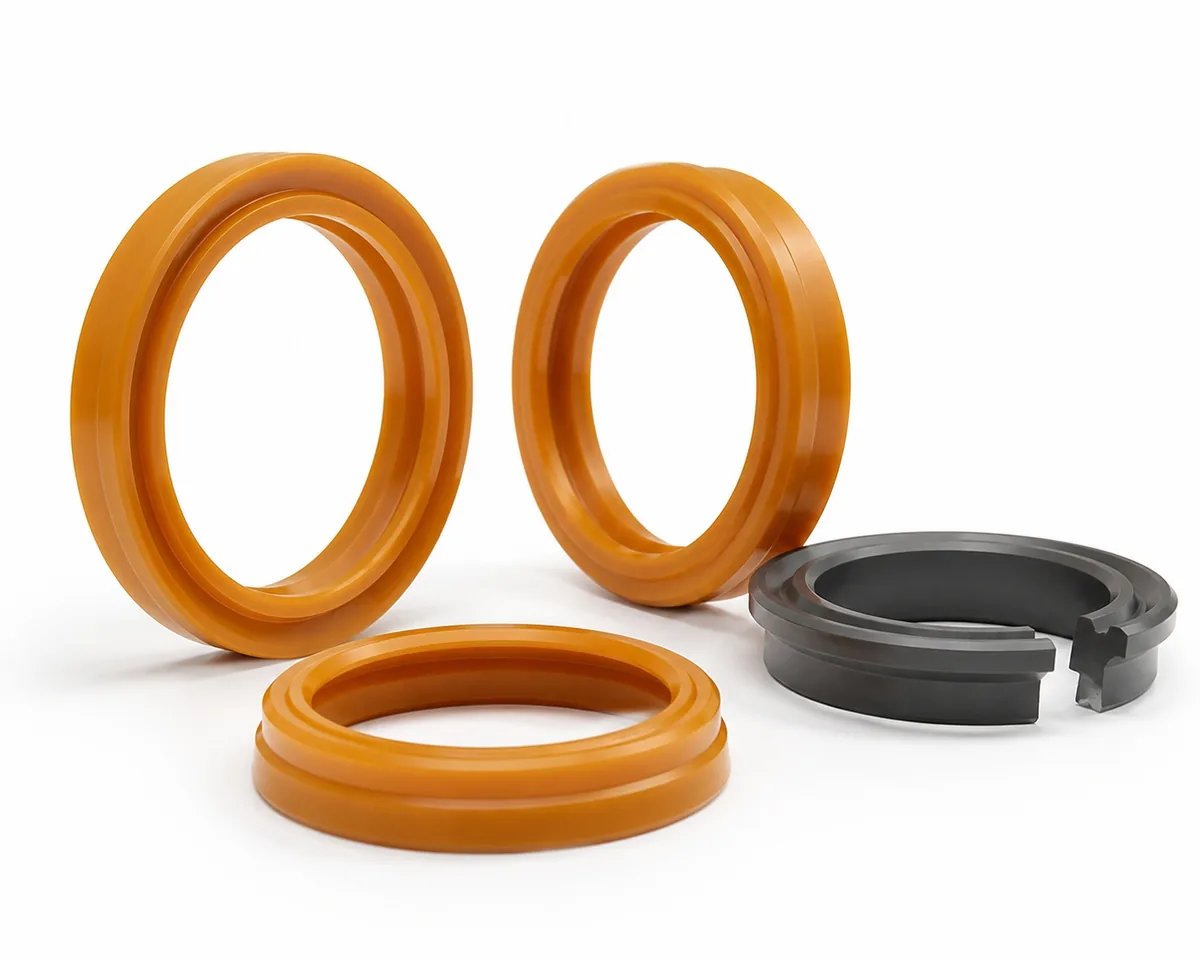
Share the seal position, dimensions, fluid and operating conditions, and the team will respond with suitable options or a request for the missing details.
Call or WhatsApp +91 9211305366.
13 — FAQs
Short answers to the questions buyers ask most often when specifying or replacing a hydraulic seal.
Hydraulic oil seals retain pressurised fluid inside pumps, cylinders and valve bodies. They limit leakage past a rod or piston, help keep dust and water out of the system, and support consistent pressure and movement. Correct selection depends on the seal position, pressure, temperature, fluid and dimensions.
The main types are piston seals, rod seals, wiper or scraper seals, backup rings, pump shaft seals and static seals such as O-rings. Each is fitted at a different position and performs a different function, so they cannot be used interchangeably.
A piston seal fits on the piston and seals against the cylinder bore, holding pressure between the two sides of the piston. A rod seal fits in the gland and seals around the moving rod to keep oil inside the cylinder. Piston seals usually see pressure from one or both faces, while rod seals are generally single-acting and are paired with a wiper.
Polyurethane is widely used for heavy-duty piston, rod and wiper seals because it resists abrasion and, in suitable profiles, extrusion under pressure. Suitability still depends on the specific PU grade, seal profile, pressure, temperature and fluid. PU is not the right choice for every hydraulic duty, and material data should be confirmed for the application.
Polyurethane (PU), nitrile rubber (NBR), fluoroelastomer (FKM/FPM), EPDM and PTFE are common, along with fabric-reinforced and thermoplastic materials for wear rings and backup rings. Selection depends on fluid compatibility, temperature, pressure, movement and groove design. EPDM, for example, is generally not suitable for petroleum-based hydraulic oils.
Start with the seal position and the equipment or OEM reference, then confirm the rod or bore diameter, groove dimensions, seal height, working and peak pressure, temperature range, fluid type and movement. Surface finish, contamination and installation method also affect performance. Confirm all dimensions before ordering.
Custom sizes and profiles may be possible where a standard seal does not match the application. Availability depends on the profile, material, dimensions, tooling and order quantity, so a drawing or sample is normally required for review. Every custom request has to be confirmed before production.
Provide the seal type and position, inside and outside diameter, cross-section or height, material if known, equipment make and model, OEM part number, and the operating pressure, temperature and fluid. A drawing, clear photograph or the old seal itself helps confirm identification.
Pressure and pressure peaks, temperature, fluid compatibility, rod or bore surface finish, alignment, contamination, speed and stroke, groove dimensions and installation quality all affect how a seal performs. A seal that is correct in size but wrong in material or profile may fail early, and damage during fitting can shorten life regardless of seal quality.
A sample, drawing or OEM part number is usually the fastest route to an accurate match. Send what you have and the team will confirm the next step.