Lubricant retention
The sealing lip holds oil or grease inside the housing so bearings and gears stay lubricated between service intervals. Once lubricant escapes, wear accelerates quietly — long before the leak is obvious.

Tractor oil seals sit at the point where a rotating shaft leaves its housing. Their job is simple to describe and demanding in service: hold lubricant where it belongs, keep dust, mud and moisture out, and protect the bearing behind them through long hours in the field. This page explains the applications, materials and dimensions worth confirming before you order.
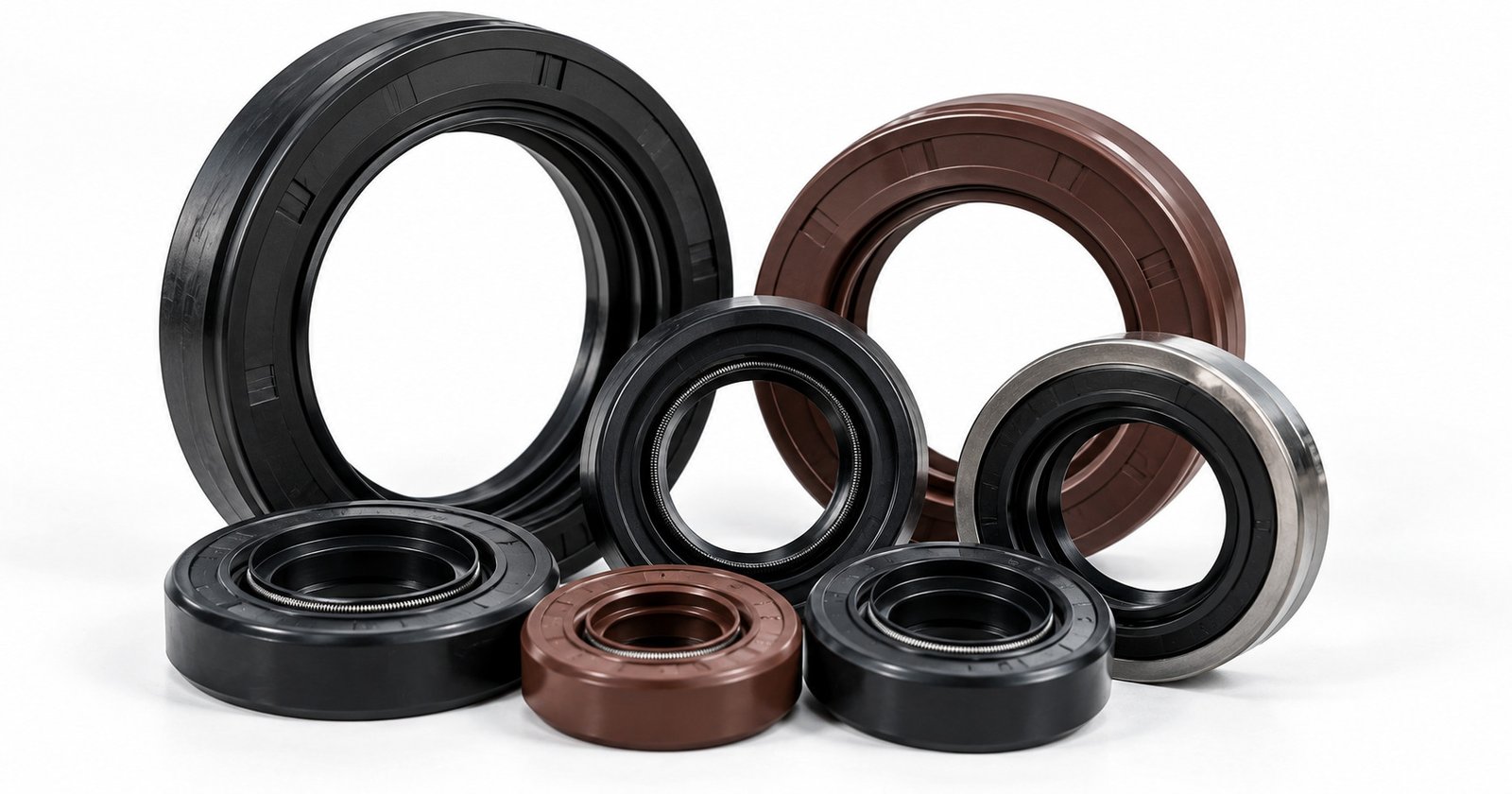
A tractor oil seal — also called a rotary shaft seal, radial lip seal or simply a shaft seal — closes the gap between a rotating shaft and the housing that carries it. A flexible sealing lip is held against the shaft, usually assisted by a small garter spring, while the outer diameter of the seal is pressed into a machined bore. The result is a compact, replaceable barrier between the lubricated interior of an assembly and the working environment outside it.
On agricultural machinery that barrier is tested continuously. A tractor works in dust, mud, crop residue, pressure-washer spray and wide temperature swings, often with the same components running for years between services. A seal that retains oil but cannot exclude abrasive dust will still allow bearing damage; a seal that keeps dirt out but is made from an elastomer unsuited to the lubricant or temperature will harden, swell or crack. Both sides of the duty matter.
Oil seals appear throughout a tractor: at the crankshaft front and rear, on camshafts and oil pump drives, in the gearbox and range units, at axle housings and wheel hubs, on PTO shafts, and in hydraulic pumps and motors. Each position has its own shaft diameter, housing bore, available width, surface speed, temperature and contamination exposure. That is why a seal is specified per position rather than per machine.
Correct selection comes down to a small set of inputs: the three key dimensions, the material, the lip and case design, and the condition of the shaft and bore it will run against. Get those right and the seal has a fair chance of doing its job. Treat the seal as a consumable chosen by guesswork and the same joint will be back in the workshop.
The sealing lip holds oil or grease inside the housing so bearings and gears stay lubricated between service intervals. Once lubricant escapes, wear accelerates quietly — long before the leak is obvious.
The same lip, together with the seal body and any auxiliary dust lip, restricts the entry of dust, mud and water. On field machinery, abrasive ingress is often more damaging than the oil loss itself.
By keeping the lubricant clean and in place, a suitable seal helps protect the shaft surface and the bearing behind it from corrosion, abrasion and premature failure — provided the rest of the assembly is in sound condition.
The four groups below cover the positions buyers most often ask about. They describe application categories and the points worth confirming — not a claim that a particular seal fits every make or model.
Axle and wheel-hub seals retain oil or grease at the final drive and wheel bearing while keeping mud, slurry and wash water away from the bearing cavity. They often work in the dirtiest position on the machine and may include an additional dust lip.
Confirm before orderingEngine oil seals are used at the crankshaft front and rear, camshaft ends and auxiliary drives. They run hot, see continuous rotation and must cope with crankcase pressure and the engine oil in use.
Confirm before orderingTransmission and driveline seals close the gearbox at input and output shafts, range and reduction units and PTO openings. Gear oil, sustained shaft speed and external dirt are the usual service conditions.
Confirm before orderingSimilar rotary shaft seals are used on implements and auxiliary equipment — hydraulic pumps and motors, steering components, water pumps and gearboxes on tillage or harvesting machinery — where the same sealing principle applies.
Confirm before orderingApplication categories describe typical sealing positions on agricultural tractors. Confirmed availability depends on the dimensions, material and design you specify — share a sample, drawing or part number so the requirement can be checked against the range.
The elastomer decides how a seal behaves when the oil is hot, the shaft turns fast or the joint is washed with slurry. Material choice is a compromise between oil resistance, temperature range, low-temperature flexibility, mechanical strength and cost — and it has to be made for the specific position, not for tractors in general.
The general-purpose choice for mineral oils, greases and many hydraulic fluids. Good mechanical strength and oil resistance at moderate temperatures, with broad availability in common sizes.
Often considered for: gearbox, axle and general shaft positionsSelected where temperatures are higher and oils or fuels are more aggressive. Better heat and chemical resistance than NBR, at a higher material cost.
Often considered for: hot engine and driveline positionsKeeps flexibility across a wide temperature band, including cold starts. Its resistance to some oils and fuels is lower than NBR or FKM, so the lubricant must be checked.
Often considered for: wide-temperature, low-load sealing dutiesDeveloped for hot lubricating oils, particularly in engine and transmission applications. Good heat and oil resistance, but limited resistance to water and some fluids.
Often considered for: hot-oil engine and gearbox sealsPTFE, polyurethane and EPDM sealing elements each suit particular duties — low friction, high pressure or water and weather exposure. They are selected only where the application justifies them.
Selected by application, not as a general substituteBefore a seal can be matched, a handful of details have to be confirmed. The table lists the parameters buyers most often need to check; use it as a checklist for your enquiry rather than as a size chart.
| Parameter | What to confirm |
|---|---|
| Inner diameter | Shaft diameter at the sealing land, measured on an unworn section, plus the specified seal bore |
| Outer diameter | Housing bore diameter and the required fit — the seal outer diameter must match the bore it is pressed into |
| Width | Available installation depth or width in the housing, including any shoulder or retaining feature |
| Seal material | Compatibility with the lubricant and the expected temperature range at that position |
| Lip design | Single or double lip, dust lip, and the sealing arrangement the assembly requires |
| Operating temperature | Expected minimum and maximum temperatures, including cold starts and sustained working heat |
| Shaft speed | Rotational speed and surface speed at the seal land under normal working conditions |
| Installation environment | Dust, mud, slurry, water spray and other contaminants the joint is exposed to |
| Seal configuration | Spring type, case construction and other design details where the assembly depends on them |
| Part identification | OEM reference, engineering drawing, sample or details of the existing seal |
Tractor oil seal dimensions are commonly quoted in this order, in millimetres — for example 40 × 62 × 10 mm. Always confirm which convention a supplier is using before comparing figures.
Final specifications depend on the particular assembly and the machine manufacturer’s design. There is no universal dimension set for tractors, and none is published here. Where the original marking is unreadable, a sample seal, drawing or part number is the most reliable starting point.
Standard sizes do not cover every tractor position, particularly on older machines, imported equipment or implements with modified assemblies. Where the requirement falls outside a catalogue size, a custom seal enquiry lets the dimensions, material and lip arrangement be reviewed together rather than forced into the nearest available size.
A useful custom enquiry starts with the physical requirement, not a product name. The points below are the inputs that let the requirement be assessed properly:
Ananta Venture is a Delhi-based manufacturer of oil seals and V belts for industrial, automotive, agricultural and heavy machinery applications. Buyers sourcing tractor oil seals in India — whether a single workshop requirement or a repeat wholesale programme — generally assess a supplier on the same practical points.
The seal must match the shaft, bore and width of the actual position, not an approximate size. Share the dimensions, part number or sample so the requirement can be checked before supply.
Repeat orders should match the part that was approved. Keep the approved dimensions, material and reference on file so later batches can be compared against the same specification.
The elastomer has to suit the lubricant, temperature and exposure of the application. State the oil and working temperature rather than relying on a generic material description.
Confirm how inner diameter, outer diameter and width will be measured and agreed, especially where a worn shaft or a non-standard bore is involved.
Where available, packing markings and reference numbers help keep received parts identifiable against the approved specification during storage and fitment.
For tractor oil seals wholesale requirements, share sizes, quantity per size and the expected schedule so availability and commercial terms can be confirmed for that enquiry.
Ananta Venture’s oil seal range also includes industrial and automotive oil seals, rubber oil seals and metal cased oil seals, alongside V belts for industrial and agricultural drives. If you need both sealing and power transmission items from one source, they can be discussed in the same enquiry.
A leaking seal is a symptom, and replacing it without understanding the cause often produces the same leak again. Work through the checks below before ordering a replacement.
Oil weeping around the shaft or housing, a damp patch that collects dust, or oil mist on nearby components. Early detection is usually cheaper than a failed bearing.
Clean the area and re-check after running the machine. Oil can travel along a housing or be thrown by a rotating shaft, so the visible wet point is not always the source.
A groove, scoring, rust pitting or a rough repair under the lip will wear a new seal quickly. Measure an unworn section of the shaft for the true diameter.
Check for corrosion, burrs, ovality and damage from a previous removal. A seal cannot seat correctly in a damaged bore, and a distorted bore will leak regardless of seal quality.
Match the dimensions, lip design and material of the original — or the corrected specification if the application has changed. Use a part number, drawing or sample wherever possible.
Follow the machine manufacturer’s service procedure for removal, cleaning, lubrication of the lip, installation depth and torque of surrounding components.
An oil seal is a low-cost component with an outsized effect on the assembly around it. Correct selection is mostly about avoiding avoidable failures.
A seal cannot compensate for a worn shaft, a damaged bore or a pressurised housing. No specific service life is guaranteed — actual performance depends on the complete assembly and how the machine is used.
Share your required dimensions, material preference, application details, part number or drawing so your requirements can be reviewed. The more specific the information, the quicker a suitable option can be identified.
Prefer the full contact page? See all contact options and directions.
Fill in what you know — unknown fields can be left blank. Sending opens WhatsApp with your enquiry prefilled; nothing is stored on this page.
Practical answers to what buyers and maintenance teams ask before ordering.
Tractor oil seals close the gap between a rotating shaft and its housing. They help retain lubricating oil or grease inside the assembly and limit the entry of dust, mud, water and other contaminants. In agricultural tractors they are used in engine, transmission, axle, wheel hub, PTO and hydraulic assemblies, depending on the design of the machine.
Confirm the shaft diameter at an unworn area, the housing bore and the available installation width. Tractor oil seal dimensions are usually written as inner diameter × outer diameter × width, for example 40 × 62 × 10 mm. Shaft condition, lip type and material also matter, so a part number, drawing or sample is the most reliable reference.
The sealing principle is the same, but the operating conditions differ. Axle and hub seals typically face mud, water and wheel-bearing duty, engine seals face heat and crankcase pressure, and transmission seals handle gear oil and sustained shaft speed. Size, lip design and elastomer therefore change from one position to another.
Nitrile rubber (NBR) is widely used for general mineral-oil sealing at moderate temperatures. Fluoroelastomer (FKM) is chosen for higher temperatures and more aggressive oils, polyacrylate (ACM) for hot lubricating oil, and silicone (VMQ) where a wide temperature range is the main requirement. The right choice depends on the lubricant, temperature, shaft speed, pressure and exposure on that machine.
Yes. Custom requirements can be reviewed against the dimensions, material, lip configuration and quantity you specify. Share a sample, engineering drawing or reference part number so the requirement can be checked, and the available options can be confirmed before you order.
Send the inner diameter, outer diameter and width, the material or a description of the lubricant and temperature, the approximate quantity, and the machine or assembly where the seal is used. A part number, drawing, clear photograph of the old seal or a physical sample helps confirm the right item.
Look for oil weeping or dripping around the shaft or housing, a build-up of dust and mud stuck to oil, and a lip that is cracked, hardened, swollen or scored. A loose or corroded garter spring also indicates a worn seal. Because shaft wear, misalignment, blocked breathers or excessive pressure can produce the same symptoms, the cause should be checked before a seal is replaced.
Yes. Bulk and wholesale enquiries are welcome. Share the sizes, estimated quantity per size and your expected schedule so the requirement can be reviewed and availability, packing and commercial terms can be confirmed for that specific enquiry.
Start with the part number or OEM reference from the workshop manual or the old seal. If that is not readable, measure the shaft, housing bore and seal width, and note the lip design and material. Where the shaft is worn, measure an unworn section and ask for advice, because fitting a seal to a damaged shaft will not solve the leak.
Send the position, dimensions and working conditions, or a sample and part number if you have them. Ananta Venture will review the requirement and confirm the options that apply.