Excavator Oil Seals for Hydraulic and Heavy-Duty Applications
The seals that keep hydraulic fluid and gear oil inside your cylinders, pumps, motors and final drives — and keep dust, water and grit out. Tell us the machine, the position and the part number, and we will help you match the right one.
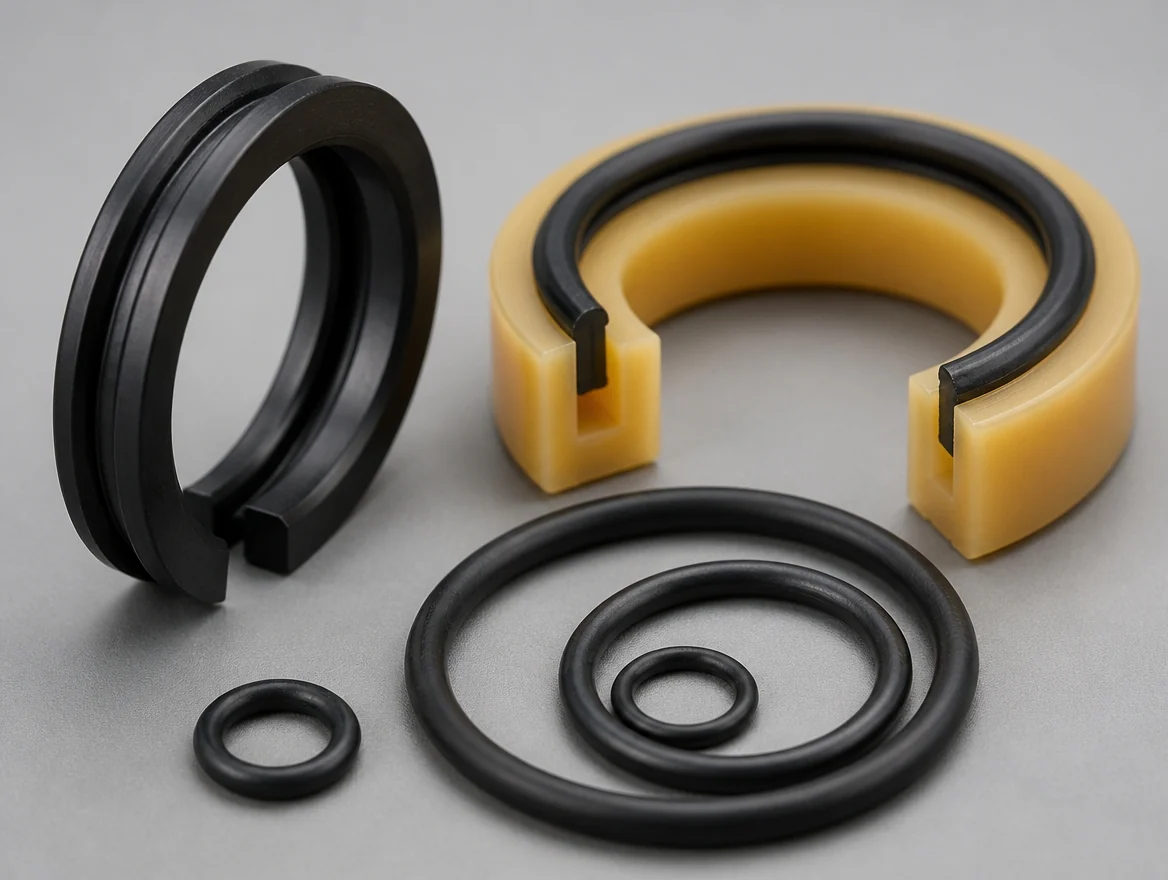
Rod and piston seals with static O-ringsA typical cylinder assembly uses several different sealing parts.
In short
Excavator oil seals are the sealing parts that stop hydraulic oil and gear lubricant escaping, and stop dirt getting in. A single machine uses several different designs — rotary shaft lip seals at pumps and motors, rod and piston seals inside cylinders, and wipers at every rod entry. The right part is identified by its position, profile, material and exact dimensions, so a part number or a photo of the old seal is the quickest way to match it.
Seal families
Rotary shaft, reciprocating and wiper seals
Compounds
NBR, FKM, PU, PTFE and others by application
Identified by
Part number, dimensions, profile, component
Based in
Burari, Delhi — manufacturer and supplier
01 Introduction
What excavator oil seals are and why they matter?
An excavator oil seal is a ring-shaped part fitted between two components to hold fluid in and keep contamination out. On one machine, that simple description covers several quite different parts — which is why the position matters as much as the size.
In the parts trade, “oil seal” is used loosely. On a single excavator it can mean the rubber lip seal at a pump shaft, the polyurethane seal on a cylinder rod, the wiper that scrapes mud off that rod, or the static O-ring sealing a gland nut that never moves. Each has a different job and none is a substitute for another.
Excavators work in conditions that punish sealing surfaces. A boom or bucket cylinder may cycle thousands of times a day under pressure, with the rod exposed to mud, grit and water on every stroke. A travel motor or final drive turns continuously under load in the same environment, and the hydraulic pump runs at high shaft speed with oil that has to stay clean for the whole service interval.
When a seal stops working, the cost goes beyond the visible leak. Lost fluid reduces the force and speed available at the cylinder, contamination accelerates wear in pumps and valves, and a failed wiper lets abrasive dust onto a rod that then scores the sealing surface. Choosing a seal that suits the position, fluid and duty is a maintenance decision, not just a purchasing detail.
A seal is only one part of a sealing system. Rod finish, bore tolerance, bushing wear, alignment and circuit pressure all affect how long a replacement lasts.
Definition
An excavator oil seal is a sealing component that retains hydraulic fluid or gear lubricant inside an excavator assembly — cylinder, pump, motor or final drive — and, where the design includes a dust lip or wiper, helps prevent external contamination from reaching the sealing surface.
Dynamic positions
Cylinder rods and pistons reciprocate, pump and motor shafts rotate, final drive pinions turn under load. These seals wear by design, and their life depends on surface finish, lubrication and contamination control.
Static positions
Gland nuts, end caps, port fittings and split housings do not move. O-rings and moulded static seals are typical here, and selection is driven by fluid, temperature and groove dimensions.
Terminology note: not every sealing component on an excavator is an oil seal. A rod seal, a piston seal, a wiper, an O-ring and a backup ring each perform a different function and are not interchangeable. Parts are matched to the position they occupy in the assembly.
02 Seal types
Types of excavator oil seals and sealing components
Grouped by how the sealing surface moves and what the part has to do. A rotary shaft seal and a cylinder rod seal can look similar in a parts photograph, but they are engineered for completely different motion, pressure and lubrication conditions.
TYPE 01
Rotary shaft lip seals
A flexible lip runs against a rotating shaft, held in a metal or rubber casing pressed into the housing. Used at pump input shafts, motor shafts and final drive pinions.
RotationOil retentionNBR / FKM
TYPE 02
Rod seals
Seal the moving rod where it leaves the cylinder gland, holding pressure on the rod side. Usually a U-cup or lip profile energised by system pressure.
ReciprocatingPressure sealPU / NBR / PTFE
TYPE 03
Piston seals
Fit on the piston outside diameter and separate the two chambers of a double-acting cylinder. They see pressure from both directions, so the profile is often symmetrical.
Double-actingBore sealingPU / PTFE
TYPE 04
Wiper and dust seals
Mounted outboard of the rod seal, a wiper scrapes mud, dust and water off the rod before it reaches the sealing lip. Often the first part to fail in earthmoving work.
Contamination barrierLow pressurePU / NBR
TYPE 05
Hydraulic pump shaft seals
Keep hydraulic oil out of the bell housing and air out of the pump case. Shaft speed and case pressure make lip geometry and heat resistance critical.
High-speed rotationShaft entrySingle / dual lip
TYPE 06
Swing, travel motor and final drive seals
Motors and final drives combine rotating shafts with gear or hydraulic oil, so they use shaft seals plus static seals on housings and covers.
Rotation under loadGear oilCased seals
TYPE 07
O-rings and static seals
Seat in a machined groove between two fixed faces — gland nuts, port plugs, valve blocks and cover plates. They seal by controlled compression, not by a flexible lip.
StaticGroove sealingNBR / FKM / EPDM
TYPE 08
Backup and wear rings
Supporting elements, not seals. Backup rings stop a lip or O-ring extruding into a clearance gap at pressure; wear rings guide the piston and carry side load.
Anti-extrusionGuidancePTFE / POM
Not sure which part you have?
A photograph of the old seal next to a rule, or the OEM part number from the parts book, is usually enough to identify the family and profile. Send it across and we will confirm the next step.
Each position on an excavator asks something different of its seals. The notes below describe what each position requires — they are not a substitute for the machine’s parts book.
Hydraulic cylinder seals
Rod, piston, wiper and static seals working together in one assembly. A full reseal replaces every sealing element in the gland and on the piston.
Reciprocating · high pressure
Boom cylinder seals
Long-stroke cylinders carrying the boom load. Sustained pressure makes rod-seal extrusion resistance and wiper condition the main concerns.
Long stroke · sustained load
Bucket cylinder seals
The most exposed cylinder on the machine. Abrasive slurry on the rod means the wiper and rod finish matter as much as the compound.
High contamination · shock loads
Hydraulic pump seals
A shaft seal keeps oil in and air out. Case pressure, shaft speed and oil temperature drive the choice between single and dual lip designs.
Rotary · high shaft speed
Swing motor seals
Swing motors rotate the upper structure with frequent reversals. Seals hold hydraulic oil at the output shaft while case pressure alternates.
Rotation · reversing duty
Travel motor seals
High torque with a hostile undercarriage. A shaft seal plus housing static seals keep hydraulic oil in and muddy water out.
Rotation · wet, abrasive
Final drive oil seals
Final drives hold gear oil around a rotating hub and pinion. Correct oil level also protects the seal from running hot.
Gear oil · continuous rotation
Need a specific position matched?
Tell us the machine model, the component and where it sits. That is usually enough to narrow the family before dimensions are confirmed.
These notes describe general sealing duty for each position. They do not confirm that a particular part fits a particular machine — fitment is confirmed against the equipment model and original part number.
04 Materials
Materials used in excavator oil seals
The compound decides how a seal behaves in contact with oil, heat and abrasion. Published temperature ranges vary by grade and manufacturer, so the notes below describe general behaviour rather than a specification for any individual part.
NBR nitrile
FKM fluoroelastomer
PU polyurethane
PTFE low friction
EPDM water & steam
General material behaviour — indicative only, confirmed per application
Material
Typically used for
Strengths
Watch-outs
NBR (nitrile)
Rotary shaft seals, O-rings, general hydraulic and gear-oil sealing
Good resistance to mineral hydraulic oil and grease, reliable at moderate temperatures, available in many profiles
Limited high-temperature life; swells in some ester-based fluids; moderate abrasion resistance
FKM (fluoroelastomer)
Higher-temperature shaft seals, O-rings and seals exposed to aggressive fluids
Wide temperature capability, strong resistance to many oils and chemicals, good retention of lip load
Higher cost; not suitable for every fluid family; poorer low-temperature flexibility than NBR
PU (polyurethane)
Rod seals, piston seals and wipers in high-pressure reciprocating service
High abrasion resistance, good extrusion resistance, low compression set, performs well under pressure spikes
Sensitive to hot water and some hydrolysing fluids; less suited to very high continuous temperature than FKM
PTFE
Low-friction lip seals, backup rings, guide and wear elements
Very low friction, dry-running tolerance, broad chemical resistance, stable at high temperature
Little elastic recovery on its own, so usually used with an energiser or spring; sensitive to installation damage
EPDM
Sealing where water, steam, glycol or brake fluid is present
Excellent water and weather resistance, good heat ageing
Poor resistance to mineral oil and grease — generally unsuitable for hydraulic oil service
Silicone and others
Special cases such as very low or high temperature sealing with low mechanical load
Wide temperature range, good flexibility at low temperature
Low tear and abrasion resistance; rarely right for a loaded dynamic seal on earthmoving equipment
Fluid compatibility comes first
Mineral hydraulic oil, biodegradable ester fluids, gear oils and brake fluids attack different elastomers in different ways. A compound that suits one machine may swell, harden or soften in another, so the fluid specification is part of the seal requirement.
Temperature is a service-life factor
Every 10 °C of sustained temperature rise accelerates elastomer ageing. A seal that is technically compatible but running near its limit will harden, lose lip load and begin to weep sooner than one specified with margin.
05 Heavy-duty performance
What decides whether a seal survives the job
Sealing performance is the result of the whole interface, not the rubber alone. Two identical seals can last very differently depending on how the machine is used and how well the surrounding parts are maintained.
Operating pressure
Many excavator main circuits run in the region of 200–350 bar, with spikes above that. Profile and backup support must suit the pressure and the clearance gap.
Temperature range
Oil heats with continuous work and cools when the machine stops. The compound must handle the working temperature, not just the ambient one.
Fluid compatibility
Oil type, additives and contamination affect swell, hardness and lip friction. The seal is selected for the fluid actually in the machine.
Shaft or rod movement
Reciprocating rods, rotating shafts and reversing motors load a lip differently. Speed, stroke length and cycle frequency all count.
Surface finish and tolerances
A rod that is too rough wears the lip; one that is too smooth can fail to hold a lubricating film. Bore roundness, clearance and alignment matter equally.
Abrasion and contamination
Quartz dust and mud are the norm on site. A working wiper and clean oil do more for seal life than any single material upgrade.
Installation conditions
Twisted lips, cut edges, dry fitting and pressing a seal in crooked are common causes of early failure, even with the correct part.
Operating environment
Water ingress, mud packing, vibration and machine attitude all change the duty a seal sees from one site to the next.
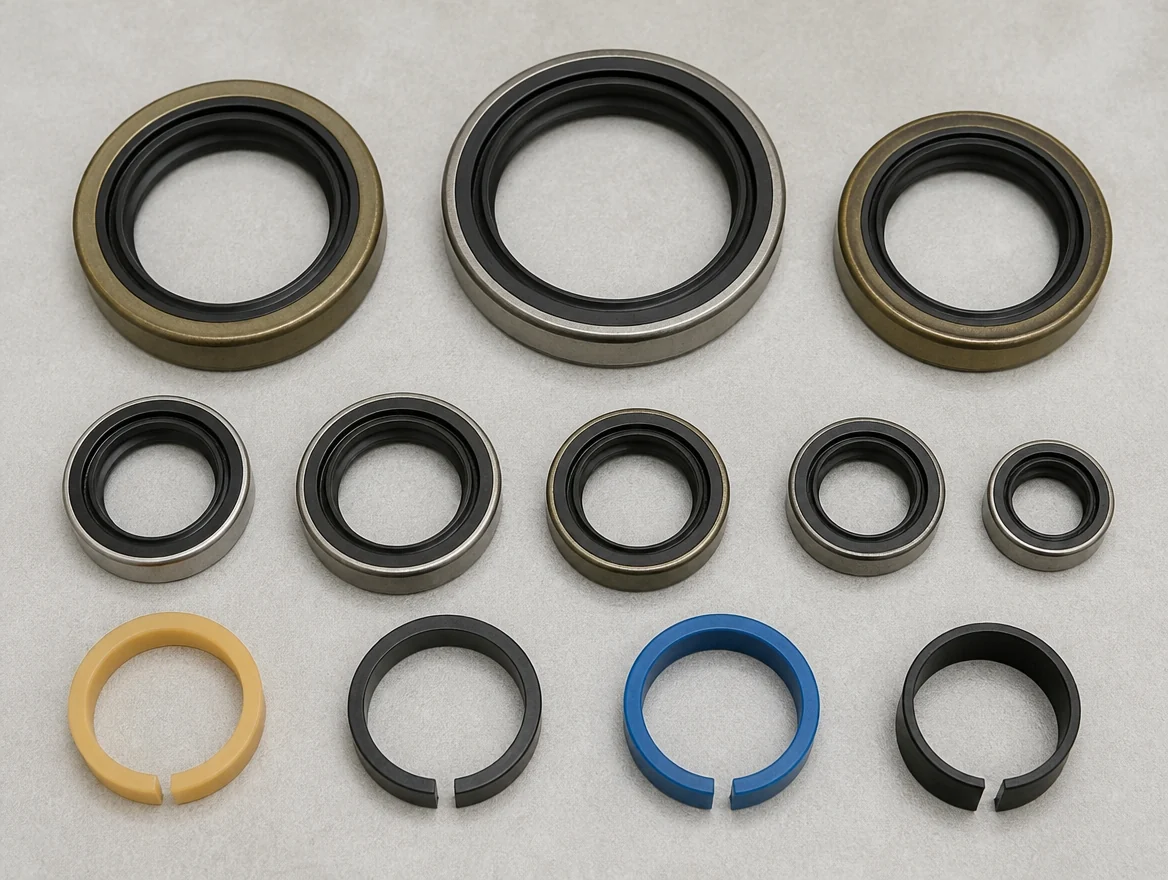
Heavy-duty seal assortment. Cased rotary seals, larger diameter rings and split wear rings — the mix of components a typical undercarriage or driveline rebuild involves. Dimensions, profile and compound are confirmed together: a part that matches on diameter but differs in profile is not a like-for-like replacement.
06 Replacement
Excavator oil seal replacement: signs and sequence
Seals rarely fail without warning. The useful skill is recognising the symptom early and confirming the cause before parts are ordered, because several different faults produce the same puddle under a machine.
Six signs that a seal needs attention
Visible hydraulic leakage
Oil weeping at a rod entry, shaft or housing joint, or a film that returns after cleaning. Confirm whether the leak is at the seal or at a fitting above it before condemning the seal.
Falling oil level
Hydraulic or gear oil that needs topping up more often than usual, with no external leak visible. Oil can also migrate past a seal into another chamber — check both sides.
Contamination at the wiper
Mud or dust packed behind the wiper, or a wiper lip that has lost contact. Once grit passes the wiper, the rod seal is lapped by abrasive on every stroke.
Hardened, cracked or worn seals
A removed seal that has lost flexibility, shows radial cracks or a flattened lip has usually seen excess heat or long service. Keep the old part — it tells you what happened.
Repeated leakage after repair
A new seal that leaks again points to the mating part: a scored rod, an out-of-round bore, worn bushing, excessive clearance or a pressure problem in the circuit.
Diagnose before replacing
Leakage, drift and oil loss can come from valve wear, relief settings or a damaged cylinder bore. Replacing seals without finding the cause often repeats the repair.
The replacement sequence in principle
These steps describe the logic of a seal replacement. They are not a workshop procedure for any specific machine: cylinder construction, gland design and torque values differ, and the manufacturer’s service manual is the authority for the equipment you are working on.
Locate the faultClean the area, run the machine and identify exactly where oil is escaping. Note whether it appears under load, at rest or both.
Confirm the componentRecord the equipment make, model and serial details, and identify the cylinder, pump, motor or final drive from the parts book.
Get the specificationsObtain the service information and the original seal part numbers or dimensions for that component.
Depressurise and secureRelease hydraulic pressure and support the equipment with rated stands — never rely on hydraulics to hold a raised boom.
Inspect the mating partsCheck rod or shaft finish, bore condition, bushing wear, clearances and alignment. Repair anything that would damage a new lip.
Install correctlyFit the specified seal the right way round, lubricate as required, protect the lip from threads and splines, and press it in squarely.
Test to procedureRefill, bleed and test at the pressures and cycles in the service manual, then re-check for weeping after the first working hours.
Safety: hydraulic systems store energy even when the engine is off, and fluid can be injected through the skin under pressure. Work only with the system depressurised, wear appropriate protection and follow the manufacturer’s procedures. Seal work on load-bearing cylinders should be carried out by qualified technicians.
07 Seal kits
Excavator seal kits for cylinder and driveline rebuilds
A seal kit bundles the sealing parts needed for one assembly, so a rebuild does not stall because one O-ring was forgotten. Contents are defined by the component — not the machine brand — and vary between production series and cylinder designs.
Rod sealThe main pressure barrier where the rod leaves the gland.
Piston sealSeparates the two chambers inside a double-acting cylinder.
Wiper sealScrapes contamination off the rod on the return stroke.
O-ringsStatic sealing at the gland nut, end cap, ports and covers.
Backup ringsSupport the seal or O-ring against extrusion at pressure.
Wear and guide ringsCarry side load and keep the piston centred in the bore.
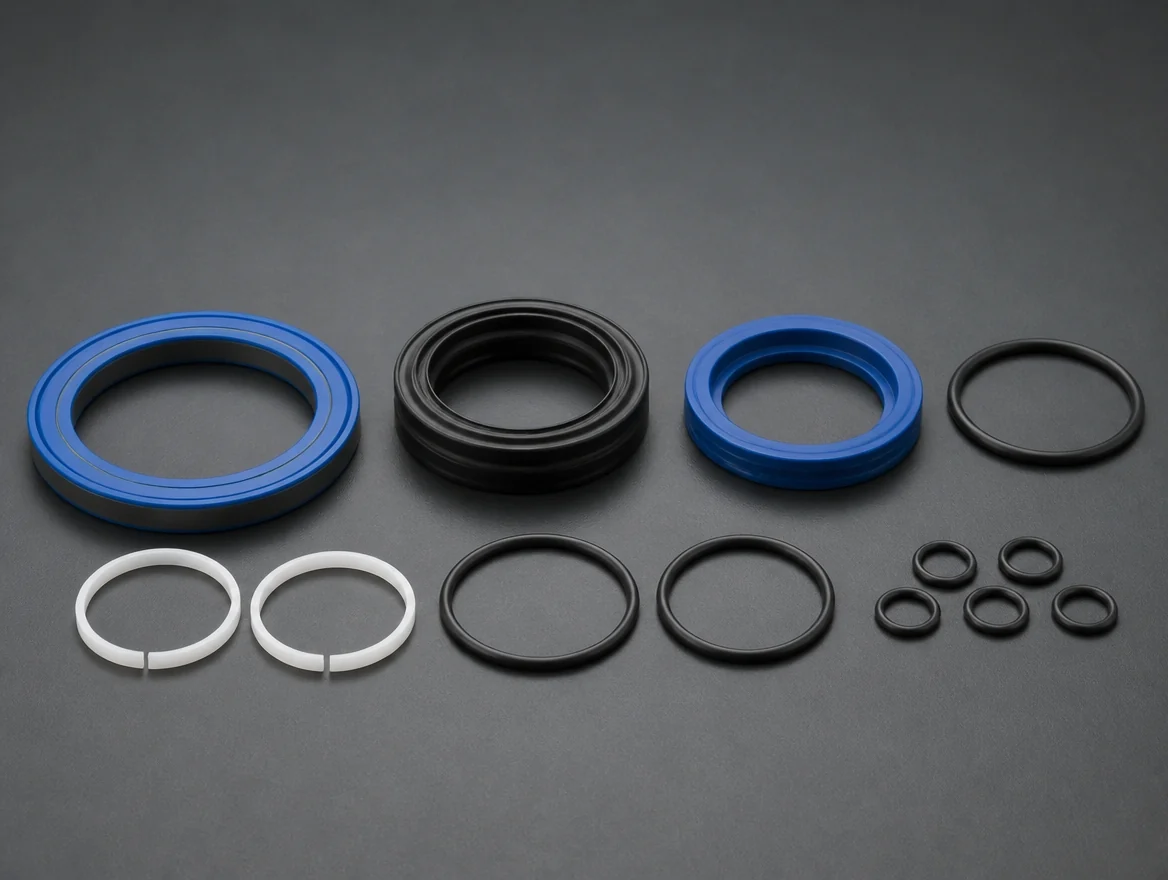
Typical kit components. Piston and rod seals, wiper, O-rings and PTFE backup rings laid out as they would be for a cylinder reseal.
One kit, one assembly — matched by part number
Kits are matched to the cylinder, pump, motor or final drive part number. Two machines that look identical can use different kits, so the assembly number is the reliable reference.
Confirm the component and position before ordering
Check the kit contents against the old parts
A photo of the old seal set helps confirm the match
A custom seal is worth considering when the required size, profile or compound is not available as a standard item — for older equipment, a modified cylinder, or an operating condition outside the usual range. The starting point is a complete description of the requirement.
Information that makes a custom enquiry workable
Existing seal part number, if one can be read
Equipment make, model and the component or assembly it fits
Inner diameter, outer diameter and width or height, plus groove or profile details
Material preference or the fluid the seal must resist
Working pressure, temperature range and movement (rotary or reciprocating)
Photographs, a drawing or a sample of the old part, and the quantity required
What to confirm before committing
Customisation is a technical and commercial decision, not an automatic service. Feasibility depends on the profile, tooling and quantity, and it is confirmed with Ananta Venture before an order is placed.
Ask for confirmation of the drawing or sample interpretation, the compound proposed, the achievable tolerances, the minimum quantity and the lead time — in writing — so the delivered part can be checked against a clear specification.
Buying a seal is a short checklist rather than a guess. Working through these points in order prevents most of the mismatches that turn into repeat repairs.
Identify the exact applicationRod seal, piston seal, wiper, shaft seal or static O-ring — and which assembly it sits in.
Verify the original part numberUse the parts book for the machine serial range. A part number is more reliable than a measurement alone.
Confirm dimensions and profileInner diameter, outer diameter, width or height, plus lip arrangement and casing type.
Check material compatibilityMatch the compound to the fluid actually in use, and to the temperature it reaches.
Consider pressure and speedWorking pressure, spikes, shaft speed or rod velocity decide whether a standard profile is adequate.
Assess contamination exposureMachines in mud, water or dust benefit from a robust wiper and protection from abrasive ingress.
Confirm the mating surfacesRod or shaft finish, bore condition, clearance and alignment must suit the seal being fitted.
Verify with the supplierConfirm the part against the machine details before ordering, especially if the old seal cannot be identified.
Selection factors and why they change the part you need
Selection factor
What to establish
Why it matters
Position and motion
Rotary shaft, reciprocating rod, piston or static joint
Determines the seal family. A rotary lip seal will not work as a cylinder rod seal, and vice versa.
Pressure
Working pressure and expected spikes
Drives lip stiffness, extrusion resistance and whether a backup ring is needed.
Fluid
Mineral hydraulic oil, gear oil, ester fluid or grease
Controls compound choice through swell, hardening and chemical attack.
Temperature
Continuous oil temperature and ambient extremes
Sets the material limit and expected service life; heat is the main ageing factor.
Speed and stroke
Shaft rpm or rod velocity, stroke length, cycle rate
Affects lip lubrication, heat generation and the risk of dry running.
Surface and clearance
Rod or shaft finish, bore roundness, diametral clearance
A rough or worn surface destroys a new lip; excess clearance invites extrusion.
Contamination
Dust, mud, water, wash-down, metal particles
Decides wiper design and whether additional protection is needed.
Installation
Housing type, access, tools available, seal depth
Some designs need a specific fitting method; a distorted seal leaks regardless of quality.
Tables like this describe general engineering factors. They do not replace the equipment manufacturer’s specification for a given machine.
10 Dimensions
Excavator oil seal dimensions and how to read them
Dimensions are the language of seal identification, but they are only part of the description. The same three numbers can describe seals with different profiles, casing types and lip arrangements — and those differences decide whether the part works.
Rotary shaft seal cross-section — the three dimensions usually quoted together
What each dimension refers to
dShaft or rod diameter. The diameter of the surface the lip runs against — usually quoted first for a rotary shaft seal.
DHousing bore. The diameter of the machined recess the seal is pressed into.
bWidth or height. The axial thickness of the seal, which must match the housing depth.
Hydraulic seals add their own dimensional requirements. Rod and piston seals are usually described by inner diameter, outer diameter and height, but groove width, groove depth, chamfer and radial clearance are part of the specification too. A U-cup, a V-ring set and a compact lip seal with the same three numbers are not interchangeable.
Measurement is a fallback, not the preferred method. Measure with a caliper across the shaft, inside the bore and across the seal width, and take each reading more than once — a worn or distorted old seal can give a misleading result. Where a drawing or part number exists, it always takes precedence.
Dimensions alone do not establish compatibility. Profile, casing, lip material, spring type, dust lip and the machine’s operating conditions all decide fitment. Send the part number, a drawing or clear photographs together with your measurements so the part can be confirmed rather than assumed.
11 Working with us
Sourcing excavator oil seals from Ananta Venture
Ananta Venture is a Delhi-based manufacturer of oil seals and V belts, supplying industrial, automotive, agricultural and heavy machinery applications from Burari, Delhi. The site covers hydraulic, PU, NBR, FKM, PTFE, EPDM, metal-cased and rubber seal families — which is where most excavator sealing requirements begin.
Identification support
Send a part number, a photograph of the old seal, a drawing or accurate measurements along with the machine details, and the team can confirm the closest match in the range before you order.
Application-based selection
Requirements are discussed by position and duty — rod, piston, wiper, shaft or static — so the profile and compound suit the job rather than only the diameter.
Direct technical communication
Requirements can be discussed by phone or WhatsApp, or sent through the contact page. Practical questions about dimensions, material and quantity are answered before an order is placed.
ManufacturerOil seals and V belts, Burari, Delhi
Seal families listedHydraulic, PU, NBR, FKM, PTFE, EPDM, metal-cased, rubber
ContactPhone, WhatsApp and the contact page
No certification, approval, capacity, stock level, minimum quantity or delivery commitment is stated on this page. Those details are confirmed directly with the team for the specific part and quantity you require.
12 Related categories
Related oil seal categories
Excavator sealing draws on several material and product families. These pages cover the categories most often used alongside earthmoving requirements.
Additional equipment-specific pages are being prepared. This section takes them without a layout change — new entries join the same grid, and each is linked only once its page is live and verified. For now, excavator requirements are handled directly through the contact page.
13 FAQs
Excavator oil seal questions, answered
Short answers to the questions that come up most often when specifying or replacing sealing components on earthmoving equipment.
What are excavator oil seals used for?
They retain hydraulic fluid and lubricating oil inside a component and help keep dust, water and grit out. On an excavator they are found at cylinder rods and pistons, hydraulic pump shafts, swing and travel motor shafts, and final drive housings, where each position calls for a different seal design.
What types of excavator oil seals are available?
Three families cover most positions: rotary shaft lip seals for rotating shafts, reciprocating hydraulic seals such as rod and piston seals, and wiper or dust seals that protect a rod entry. Static O-rings, backup rings and wear rings support these seals but are not oil seals themselves.
How do I identify the correct excavator oil seal size?
Start with the original part number from the parts book or the old seal. If that is not readable, measure the shaft or rod diameter, the housing bore and the seal width or height with a caliper, and note the profile and lip arrangement. Record the equipment make and model as well, because identical dimensions can appear in different profiles.
When should excavator oil seals be replaced?
Inspect when you see hydraulic oil weeping or pooling at a rod, shaft or housing, faster-than-normal oil consumption, dust building up under a wiper, or a seal that has hardened, cracked or worn. Diagnose the cause first: a scored rod, worn bushing or over-pressurised circuit will destroy a new seal as quickly as the old one.
What materials are used in excavator hydraulic oil seals?
NBR is common for general mineral-oil service, FKM for higher temperatures and aggressive fluids, polyurethane for high-pressure and high-wear reciprocating seals, and PTFE for low-friction or chemically demanding duties. Suitability depends on the fluid, temperature, pressure and surface finish, so the compound is confirmed per application.
Can I get custom excavator oil seals?
Non-standard sizes, profiles and compounds can sometimes be made to drawing or sample. Send the dimensions, material requirement and operating conditions so feasibility, tooling, quantity and lead time can be confirmed before you commit to an order.
How do I choose the right excavator seal kit?
Match the kit to the exact cylinder, pump, motor or final drive rather than to the machine brand alone. Confirm the component part number and the kit contents, because kits for the same machine can differ by production series and by whether the cylinder is rebuilt or only resealed.
What information should I provide when sourcing excavator oil seals?
The seal part number if available, equipment make and model, the component and position, inner and outer diameters with width or height, the material or fluid requirement, and the operating pressure and temperature. A photograph of the old seal, a drawing or a sample removes most of the guesswork.
Share your seal part number, equipment details or dimensional requirements to discuss the most suitable product options for your application. A photograph of the old seal is often the fastest starting point.