Single Lip Oil Seals
One sealing lip for lubricant retention in clean, well-protected housings — gearboxes, motors and pumps working indoors. The simplest and most economical construction where dust is not a factor.

Sealing products · Burari, Delhi
Rubber rotary shaft seals that hold lubricant inside a bearing or gear chamber and keep dust, water and grit out — supplied in NBR, FKM, silicone and EPDM to the shaft diameter, bore and width your machine actually uses.
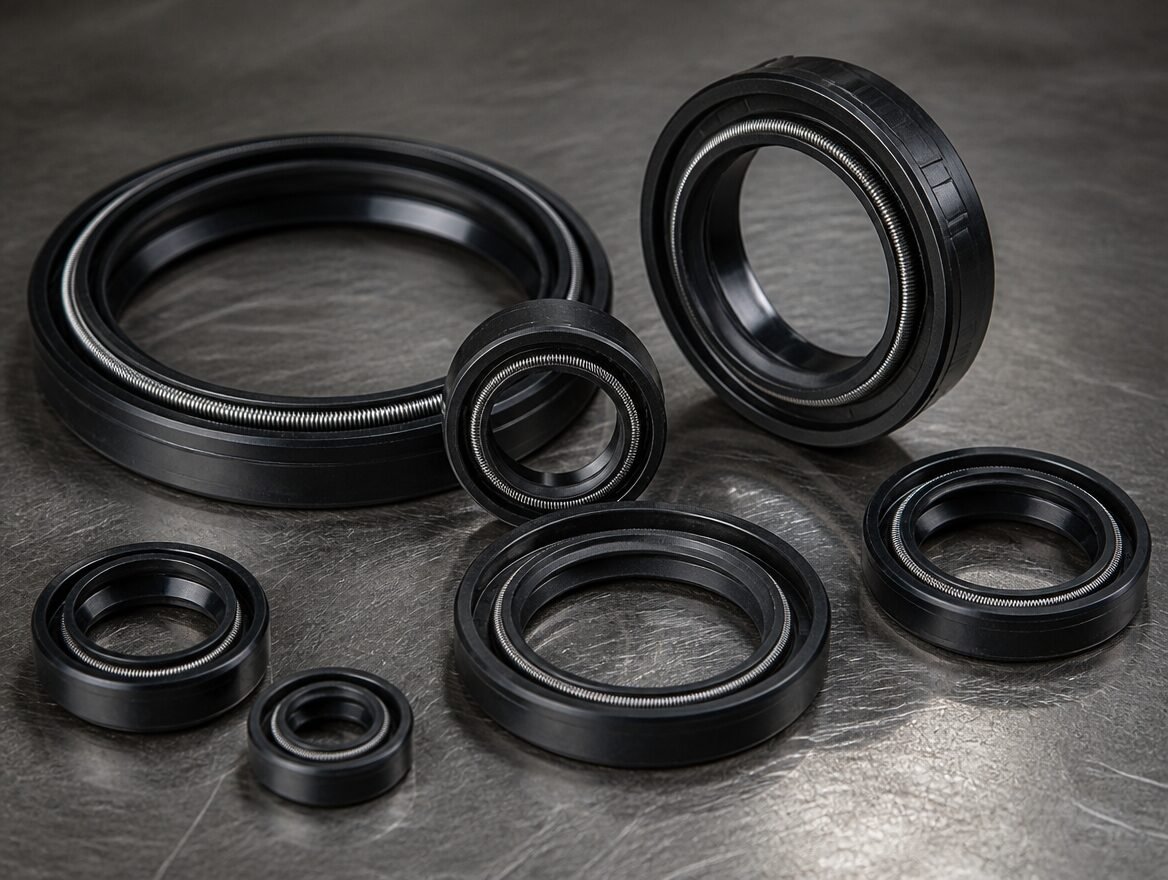 Rotary shaft seals
Overview
A rubber oil seal sits at the point where a shaft leaves its housing. It is the cheapest component in that assembly and the one that usually fails first — which is why the specification deserves more attention than the part number alone.
Ananta Venture supplies rubber oil seals for gearboxes, electric motors, pumps, automotive drivelines, tractors and construction equipment. Seals are produced in the dimensions an application needs, in single-lip and double-lip constructions, with rubber-covered or metal-cased outer diameters, and in the elastomer that suits the fluid and temperature of the duty.
Because seal pricing depends on size, compound, lip configuration and order quantity, this page does not publish a fixed price list. Tell us the dimensions and the application, and you get a quotation for the actual part rather than a catalogue figure that changes with every size.
The basics
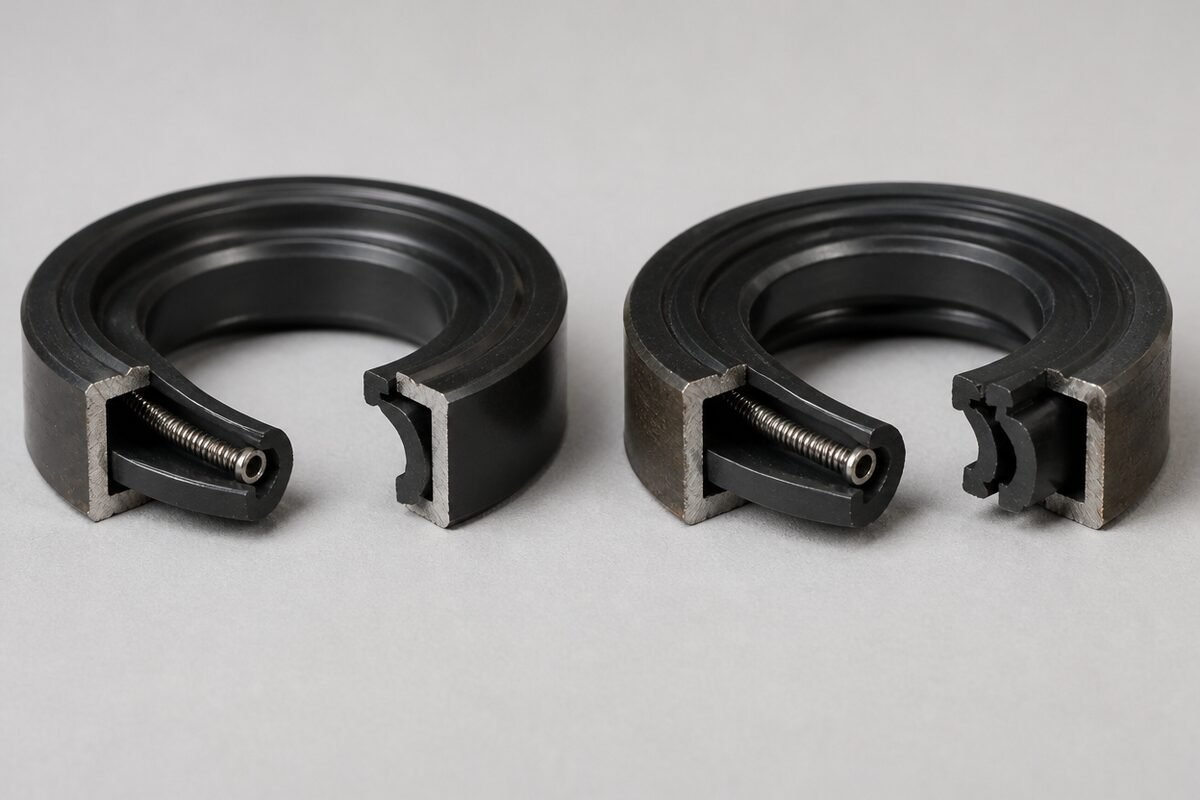
A rubber oil seal — also called a radial lip seal, rotary shaft seal or simply an oil seal — is a ring-shaped component with a flexible elastomer lip that bears on a rotating shaft. The lip is held against the shaft by its own moulded geometry and by a small coil spring, while a rigid case keeps the seal seated and round in the housing bore.
Retention. The sealing lip holds oil or grease inside the bearing or gear chamber. Lubricant that escapes lowers the oil level, starves the bearing and ends up on the floor or the product.
Exclusion. The same lip — or a second lip on the outside — blocks dust, water, mud and metal particles from entering. In farm, construction and mining duty, exclusion is often the harder job, and the reason a double-lip seal is specified instead of a single-lip one.
The lip contact line holds oil or grease in the housing while the shaft turns. Contact pressure has to be high enough to seal and low enough not to overheat the lip.
A dust lip, a rubber-covered outer diameter or a protected lip profile keeps grit away from the sealing edge — the difference between a season and a shift in dirty duty.
As the lip beds in and wears, the garter spring maintains steady radial force, so sealing performance does not depend on the moulded lip alone.
Construction
Five parts do the work. Understanding them explains why two seals with identical 20 × 35 × 7 mm dimensions can behave very differently in service.
Product types
Construction follows the duty: how much dirt reaches the seal, whether the housing is aluminium or cast iron, and whether the position sees pressure or only splash.
One sealing lip for lubricant retention in clean, well-protected housings — gearboxes, motors and pumps working indoors. The simplest and most economical construction where dust is not a factor.
A main lip plus a secondary dust lip. Specified for farm machinery, construction equipment and any position exposed to mud, slurry or washdown, where the outer lip protects the sealing edge.
Double lip with a rubber-covered outer diameter — the general-purpose industrial and automotive construction. The rubber OD seals against the bore and absorbs small housing imperfections.
Single lip with a rubber-covered outer diameter. Used where exclusion is handled elsewhere or the duty is clean, and where a softer bore interface is preferred over a metal shell.
Bare steel outer shell pressed into a machined bore. Strong and dimensionally stable for cast-iron and steel housings, and suited to higher press-fit retention.
Elastomer bonded over the case, inside and out. Better bore sealing on aluminium housings and differentials, and useful where thermal expansion differs between housing and seal.
Non-standard diameters, widths, lip profiles and compounds are discussed against the application rather than a stock list. Share a drawing, a sample or the three measurements and the feasible options are confirmed before quotation. Designations such as TC and TB also vary between manufacturers — the drawing matters more than the letters.
Compounds
The elastomer decides how the lip behaves in the fluid, at temperature and over time. The notes below are general industry guidance for each family — the compound actually supplied for your duty is confirmed against the media and operating conditions before an order.
The workhorse of oil sealing: good resistance to mineral oils, greases and many fuels, with useful mechanical strength and moderate cost. The default choice for gearboxes, motors, pumps and automotive drivelines running on petroleum-based lubricants at ordinary temperatures.
Chosen where NBR runs out of temperature or chemical headroom: hot engine and gear oils, aggressive additives, and higher continuous heat. Costs materially more, and the grade must be matched because FKM families differ in what they resist.
Holds flexibility across a very wide temperature band, including cold starts where other rubbers stiffen. Mechanical strength, tear resistance and dynamic wear behaviour are lower, so it suits light-duty and temperature-critical positions rather than high-speed loaded lips.
Excellent against water, steam, weather and many polar fluids — useful for washdown, outdoor and brake-system positions. It is generally unsuitable for petroleum-based oils and greases, where it swells and degrades, so it is not a general-purpose oil seal material.
| Property | NBR | FKM | Silicone (VMQ) | EPDM |
|---|---|---|---|---|
| Mineral oil & grease | Good | Very good | Fair to moderate | Poor |
| Heat resistance | Moderate | High | High | Good |
| Low-temperature flexibility | Moderate | Limited | Very good | Good |
| Water & steam | Fair | Moderate | Fair | Very good |
| Weather & ozone | Fair | Very good | Very good | Very good |
| Mechanical strength / wear | Good | Good | Low | Good |
| Relative cost | Low | High | Moderate to high | Moderate |
| Typical oil-seal role | General purpose | Hot / aggressive media | Wide-temperature, light duty | Water-side, not oil |
Note: generic temperature figures quoted across the industry are not product guarantees. Seal life depends on the compound batch, lip geometry, shaft finish, speed, pressure and contamination together. Ananta Venture does not publish a blanket temperature rating for a size — the suitable compound and its limits are confirmed for each enquiry.
Dimensions
Oil seals are always specified in the order ID × OD × Width, in millimetres. Reading the three numbers correctly is the difference between a seal that presses in and one that leaks from day one.
| Size (ID × OD × W) | ID (mm) | OD (mm) | Width (mm) | Common construction | Typical position |
|---|---|---|---|---|---|
| 10 × 22 × 7 | 10 | 22 | 7 | TC double lip / TB single lip | Small shafts, pumps, gear reducers |
| 12 × 24 × 7 | 12 | 24 | 7 | TC double lip | Small motors, water pumps |
| 15 × 30 × 7 | 15 | 30 | 7 | TC double lip / TB single lip | Motor bearing housings, small gearboxes |
| 17 × 30 × 7 | 17 | 30 | 7 | TC double lip | Pump shafts, fan drives |
| 20 × 35 × 7 | 20 | 35 | 7 | TC double lip / TB single lip | Gearbox input shafts, motors, pumps |
| 22 × 40 × 7 | 22 | 40 | 7 | TC double lip | Small reduction gearboxes |
| 24 × 40 × 7 | 24 | 40 | 7 | TC double lip | Motor shafts, pump bearing covers |
| 25 × 40 × 7 | 25 | 40 | 7 | TC / TB / metal cased | Gearbox and motor shafts |
| 25 × 47 × 7 | 25 | 47 | 7 | TC double lip | Gearboxes, machine tool spindles |
| 25 × 50 × 10 | 25 | 50 | 10 | TC double lip | Bearing housings, larger pump shafts |
| 25 × 55 × 10 | 25 | 55 | 10 | TC double lip | Gear reducers, drive shafts |
| 28 × 47 × 7 | 28 | 47 | 7 | TC double lip | Motors, pump covers |
| 30 × 47 × 7 | 30 | 47 | 7 | TC / TB / metal cased | Gearbox shafts, electric motors |
| 32 × 52 × 8 | 32 | 52 | 8 | TC double lip | Machine tools, gearboxes |
| 35 × 52 × 8 | 35 | 52 | 8 | TC double lip | Agricultural gearboxes, industrial drives |
| 38 × 58 × 8 | 38 | 58 | 8 | TC double lip | Pumps, compressors, transmissions |
| 40 × 62 × 8 | 40 | 62 | 8 | TC / TB | Pump and motor shafts |
| 42 × 62 × 8 | 42 | 62 | 8 | TC double lip | Gearboxes, heavy pump shafts |
| 45 × 62 × 8 | 45 | 62 | 8 | TC double lip | Agricultural and industrial gearboxes |
| 50 × 72 × 8 | 50 | 72 | 8 | TC / TB | Heavy duty shaft and bearing housings |
| 55 × 80 × 8 | 55 | 80 | 8 | TC double lip | Crushers, conveyors, large pumps |
| 60 × 85 × 8 | 60 | 85 | 8 | TC double lip | Large gearboxes, heavy machinery |
| 70 × 90 × 10 | 70 | 90 | 10 | TC double lip | Heavy industrial drives |
| 80 × 100 × 10 | 80 | 100 | 10 | TC double lip | Mills, crushers, large pumps |
| 90 × 120 × 12 | 90 | 120 | 12 | TC double lip | Large bore shafts, heavy equipment |
Scroll the table sideways to see all columns.
Need a size that is not listed? Non-standard and intermediate dimensions are quoted against the shaft and bore measurements — see custom size rubber oil seals.
Product catalogue
Ten of the sizes most often requested, shown in a product-card view. Every card is an enquiry item, not a stocked SKU with a published price — select the size, check the construction, and send the quantity you need for a quotation.
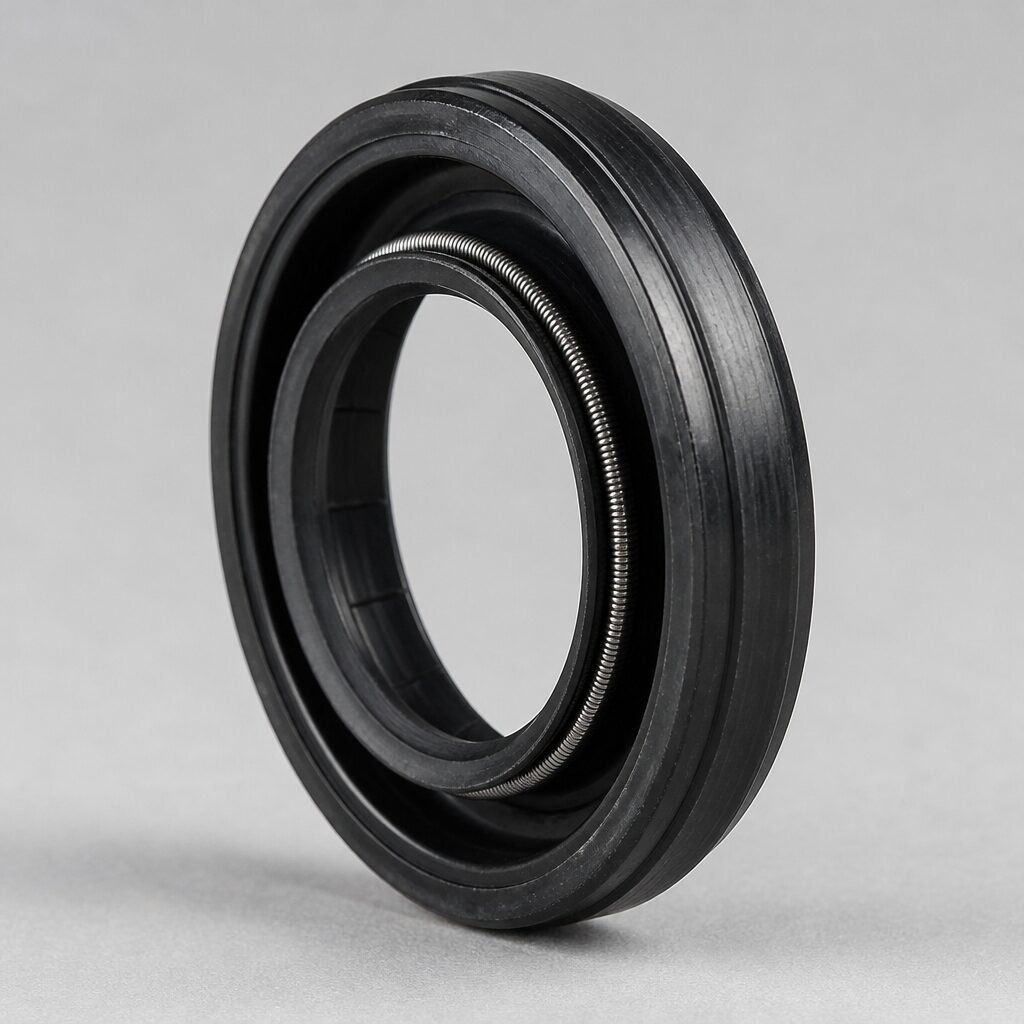 TC · double lip
Rotary shaft oil seal
Small-shaft seal for gearbox inputs, motor bearing housings and pump shafts. Available as a double-lip TC seal for dusty positions or a single-lip TB seal for clean ones. NBR is standard; FKM and silicone can be quoted where the oil or temperature requires it.
Availability and compound confirmed per order. Bulk pricing on request.
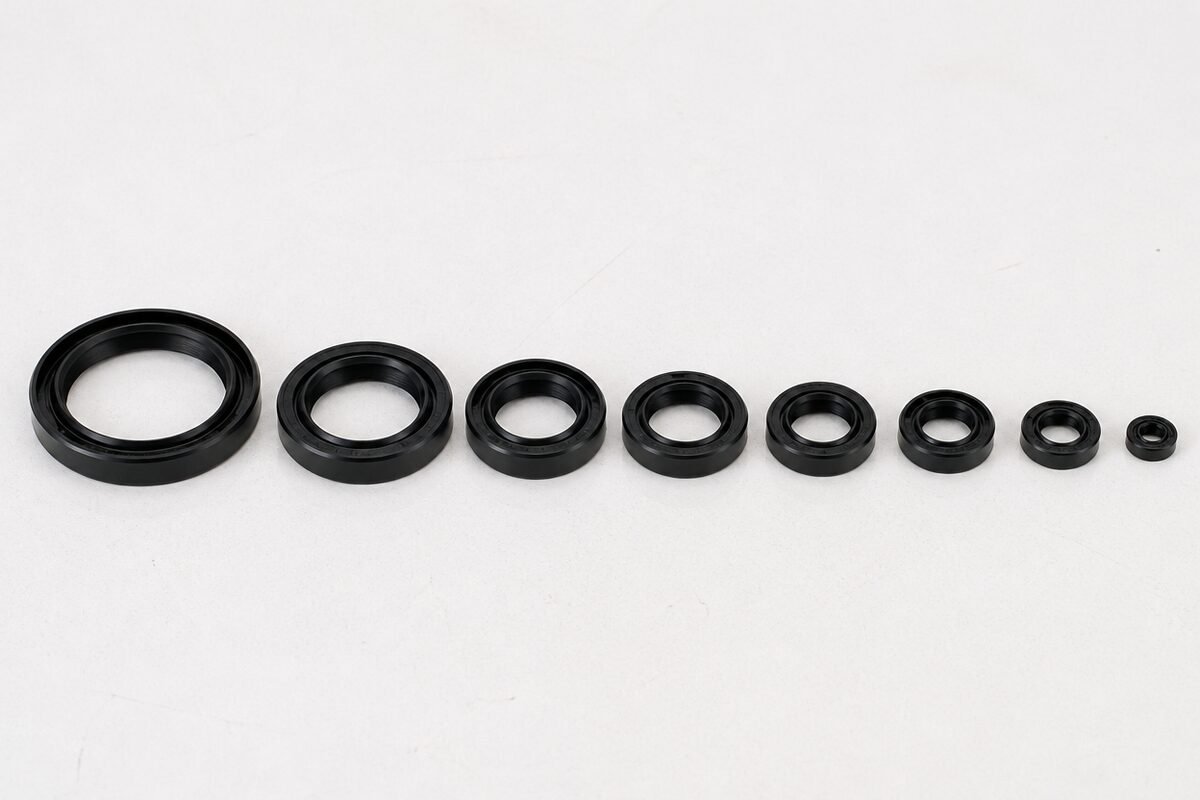 TC · double lip
Rotary shaft oil seal
Common on small motor shafts and pump bearing covers where the housing is aluminium and a rubber-covered OD seals better than a bare metal shell. Single-lip TB construction can be quoted for clean duties.
Availability and compound confirmed per order.
TC / TB / metal
Rotary shaft oil seal
One of the most widely used metric seal sizes on Indian machinery. Supplied as a double-lip TC seal as standard, with single-lip TB or metal-cased options where the housing and duty call for them.
Availability and compound confirmed per order.
 TC · double lip
Rotary shaft oil seal
The wider 10 mm section suits deeper housing pockets and positions where shaft deflection is higher. Often specified on pump shafts and bearing covers rather than on small gearbox inputs.
Availability and compound confirmed per order.
TC / TB / metal
Rotary shaft oil seal
A frequent replacement size on electric motors and smaller industrial gearboxes. Metal-cased construction is often preferred where the housing bore is machined steel or cast iron.
Availability and compound confirmed per order.
 TC · double lip
Rotary shaft oil seal
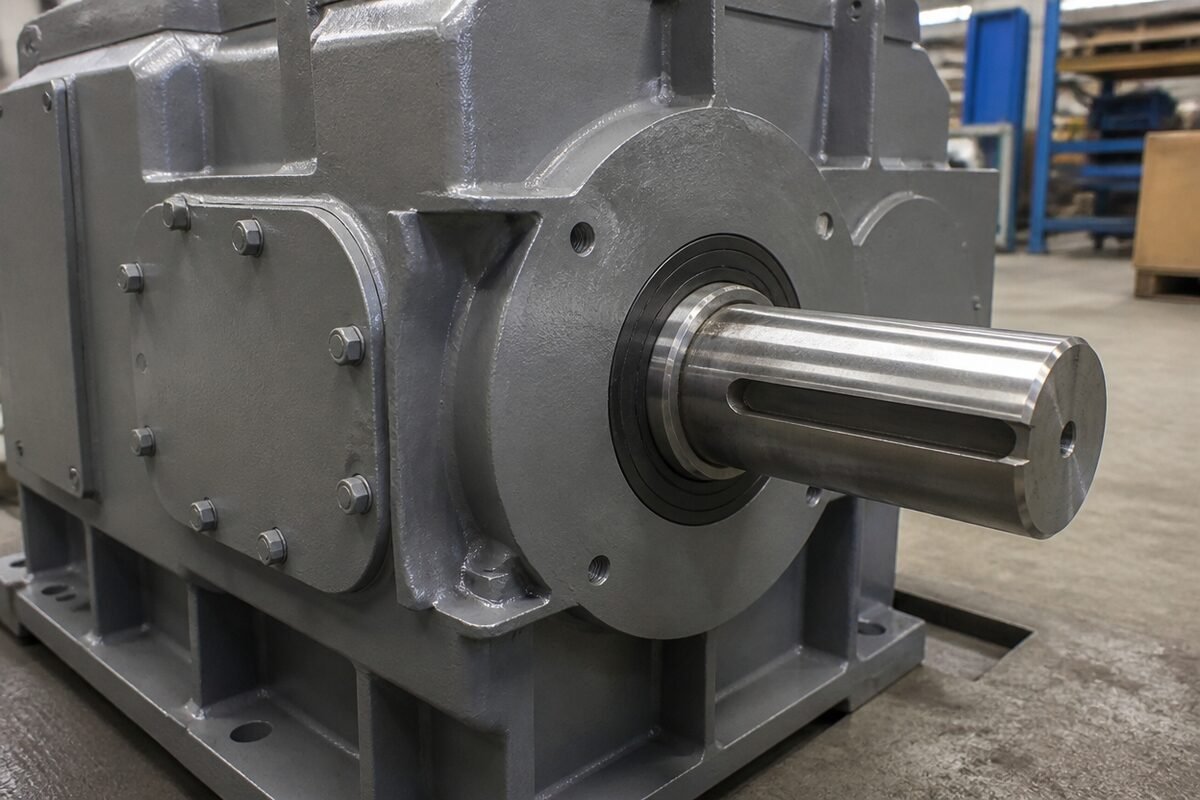
A common agricultural and industrial gearbox size, usually supplied as a double-lip seal because these positions see dust, mud and washdown. Confirm the housing depth before ordering a 10 mm variant.
Availability and compound confirmed per order.
 TC · double lip
Rotary shaft oil seal
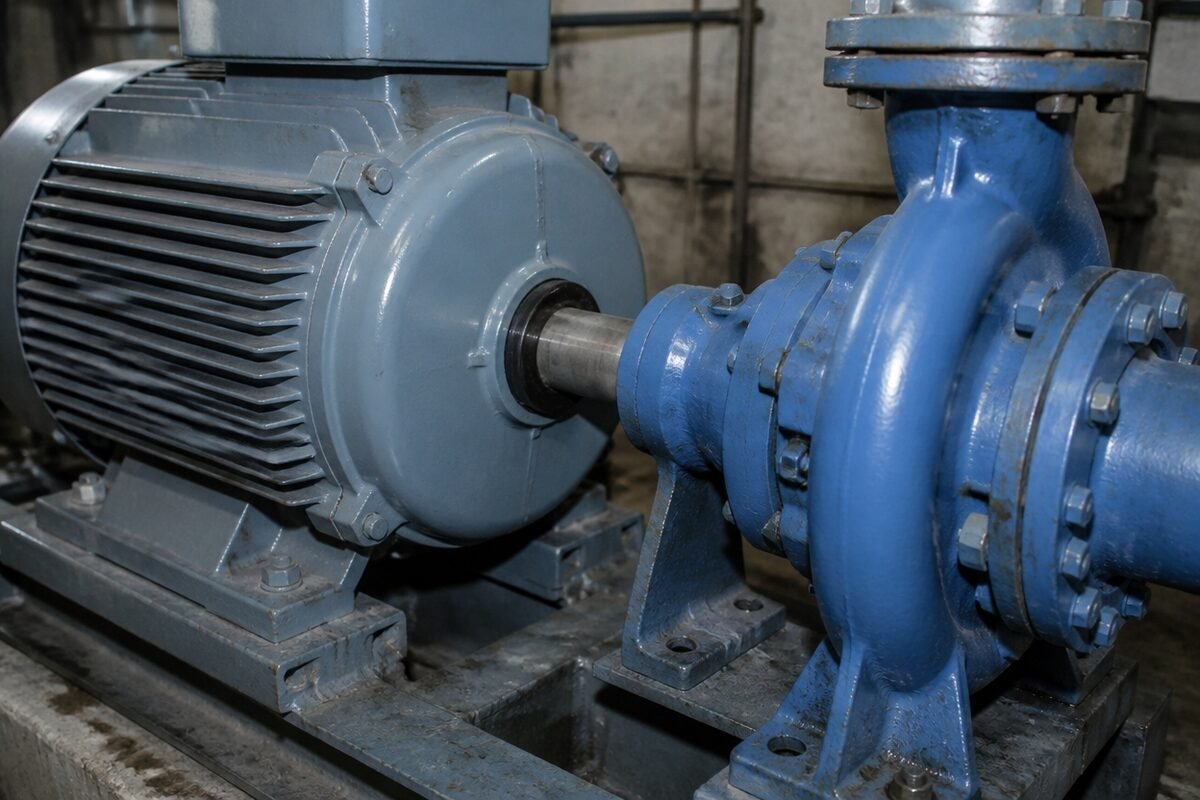
Used on pump shafts and larger motor bearing housings. If the pump handles a fluid other than mineral oil, the compound has to be checked against the media before NBR is assumed.
Availability and compound confirmed per order.
TC / TB
Rotary shaft oil seal
Mid-to-large shaft seal for pumps, drive assemblies and heavy bearing housings. On larger diameters, shaft run-out and surface finish matter more than on small seals — check both before fitting.
Availability and compound confirmed per order.
TC · double lip
Rotary shaft oil seal
For large gearboxes, crushers and heavy rotating assemblies. Double-lip construction is usual where the position is exposed to grit; confirm housing depth and bore condition during replacement.
Availability and compound confirmed per order.
TC · double lip
Rotary shaft oil seal
Large-bore seal for heavy industrial equipment. At this diameter, press-fit squareness and bore surface condition dominate seal life; a new seal in a scored bore will leak again.
Availability and compound confirmed per order.
Catalogue note: these ten entries are a representative selection, not a stock list, and no price or lead time is implied for them. Every seal is quoted against the confirmed size, compound, construction and quantity. Product images on this page are illustrative and do not represent a specific finished part.
Market reference
Buyers often ask for a price before they share a size. The table below records what third-party Indian sellers were publishing for specific sizes on 6 November 2026, so you can see how price moves with diameter, construction, brand and pack size. These are not Ananta Venture prices.
NBR seals in roughly the 20–30 mm bore range, sold singly or in packs of ten. The lowest prices in the market sit here, and differences between sellers are mostly brand and pack quantity.
35–65 mm bore seals. Price climbs with diameter and with double-lip or rubber-covered construction, and branded seals (SKF, CR) move well above unbranded equivalents.
100 mm-plus bores, and imported branded seals, are priced individually. At this level, availability and material certification often matter more than the per-piece difference.
| Size (ID × OD × W) | Material | Type | Published price | Unit | MOQ / pack | Supplier | Source |
|---|---|---|---|---|---|---|---|
| 20 × 35 × 7 | NBR | Oil seal | ₹20 | Per piece | 10 pcs pack | IndiaMART seller | Listing |
| 24 × 40 × 7 | NBR | Mahak oil seal | ₹25 | Per piece | — | IndiaMART seller | Listing |
| 25 × 40 × 7 | NBR | Tractor oil seal | ₹25 | Per piece | — | Auto Friends Co. | Listing |
| 25 × 40 × 7 | NBR | SKF oil seal | ₹50 | Per piece | — | IndiaMART seller | Listing |
| 25 × 47 × 7 | NBR | Machinery oil seal | ₹25 | Per piece | — | IndiaMART seller | Listing |
| 35 × 47 × 10 | NBR | Rubber oil seal | ₹25 | Per piece | — | IndiaMART seller | Listing |
| 35 × 52 × 8 | NBR | Agricultural oil seal | ₹30 | Per piece | — | IndiaMART seller | Listing |
| 45 × 62 × 8 | NBR | Agricultural oilseal | ₹32 | Per piece | — | IndiaMART seller | Listing |
| 70 × 90 × 10 | NBR | Oil seal | ₹48 | Per piece | — | IndiaMART seller | Listing |
| 50 × 72 × 8 | NBR | Double lip, pack of 2 | ₹280 (₹140/pc) | Per pack | 2 pcs pack | Amazon.in seller | Listing |
| 65 × 110 × 13 | NBR | Oil seal | ₹90 | Per piece | — | IndiaMART seller | Listing |
| 90 × 120 × 12 | Rubber / NBR | Oil seal | ₹45 | Per piece | — | IndiaMART seller | Listing |
| 170 × 200 × 13 | NBR | Oil seal | ₹199 | Per piece | — | IndiaMART seller | Listing |
Scroll the table sideways to see all columns.
Where they are used
Every application below needs the same two things — lubricant kept in and contamination kept out — but each one punishes the seal differently. The notes describe what to check; they do not imply that one seal suits every machine listed.
Engine front and rear positions, gearbox shafts, differential pinions and wheel hubs — places where oil loss is noticed quickly and road dust is constant.
Tractor gearboxes, rotavators, power tillers, threshers and harvesters work in dust, mud and crop residue — the harshest routine duty an oil seal faces.
Excavators, loaders, crushers and earthmoving equipment combine shock loads, vibration and abrasive dust around every rotating joint.
Compressors, conveyors, mixers, machine tools and production lines run long shifts; a seal that weeps onto a product or a floor becomes a quality and safety issue.
Mills, crushers, large pumps and heavy gearboxes use seals from 90 mm bore upwards, where press-fit squareness and bore condition decide service life.
If the old seal has no markings, tell us the machine, the position on the shaft and the oil used. That context usually narrows the construction and compound before a measurement is taken.
Ask for help identifying itBuyer's guide
Ten details decide whether a seal lasts a season or a shift. Work through them in order — dimensions first, then duty, then construction.
Measure the shaft at the sealing position, not at an unworn section. A worn groove means the new lip will run on a damaged surface.
The bore decides the outer diameter and press fit. Check for scoring, out-of-roundness and previous seal damage.
Match the housing depth. A seal that is too wide will not seat; too narrow leaves the lip unsupported.
Mineral oil, gear oil, grease, hydraulic fluid, water-based media and fuels each behave differently with NBR, FKM, silicone and EPDM. Media comes before temperature.
Use the temperature at the seal, not the ambient figure. Continuous heat ages rubber; peaks decide the compound's safety margin.
Surface speed at the lip generates heat. High-speed shafts need a suitable lip profile and a fine shaft finish.
Most lip seals are designed for little or no pressure differential. Where pressure exists, the housing and seal design must account for it.
Dust, mud, slurry and washdown point to a double lip, a protected lip or a rubber-covered OD instead of a basic single lip.
A fine, concentric shaft surface with adequate hardness supports a long lip life. A rough or hardened-then-worn shaft destroys a new seal quickly.
Access, tools, bore chamfer and whether the shaft can be protected during fitting often decide whether the seal survives the first hour.
Perfect data is not required. Size, machine and quantity are enough to start.
Request a quoteTechnical data
The fields below are what a seal specification is built from. Values are confirmed against the application — this page does not publish blanket performance ratings, because a single figure would be wrong for most duties.
| Product type | Rubber oil seals for rotary shaft and general machine sealing positions |
|---|---|
| Construction | Single lip, double lip, TC, TB, metal-cased and rubber-covered |
| Compounds | NBR, FKM, silicone (VMQ), EPDM; other elastomers discussed where the duty requires |
| Inner diameter | Matched to the shaft diameter of the application |
| Outer diameter | Matched to the housing bore of the application |
| Width | Matched to the housing depth of the application |
| Garter spring | Fitted where the construction calls for it; material confirmed with the seal |
| Temperature range | Depends on the selected compound and media — confirmed per enquiry |
| Media compatibility | Selected against the fluid: mineral oils, gear oils, greases, fuels, water-based and other media |
| Customisation | Dimensions, compound, lip design and construction discussed against the application and quantity |
| Packaging | Bulk packing or individual packing as agreed for the order |
A number such as “−40 °C to +120 °C” describes a compound family, not a seal in your machine. Actual limits move with compound formulation, lip geometry, shaft speed, media and the acceptable service life. Two seals in the same size can differ by tens of degrees.
So the specification is written for the enquiry: the compound is selected against your media and temperature, and the construction against your contamination and speed. If a duty sits outside what a standard compound can hold, we will say so rather than quote a part that will fail early.
Troubleshooting
Most seal failures are diagnosed as “bad rubber” and are actually installation or shaft problems. These are the causes worth checking before the next seal goes in.
The lip loses elasticity, flattens and stops following the shaft. Usually a compound chosen below the real operating temperature.
CheckActual seal temperature, not ambient; consider FKM or a higher-grade compound.A groove forms where the lip has run for years, so a new seal cannot find a clean surface to seal against.
CheckShaft at the contact line; a speedi-sleeve or shaft repair may be needed.Machining lead marks pump oil along the shaft; a rough finish abrades the lip edge.
CheckSurface finish and direction of machining; re-finish if required.Fitting a seal dry, or dragging it over a keyway or thread, scores the lip before it ever runs.
CheckLubricate the lip, cover sharp edges, press squarely with a proper driver.Swell, softening or cracking after a few weeks usually means the elastomer and the fluid do not match — EPDM in mineral oil is the classic example.
CheckThe actual fluid, including additives and contamination; re-select the compound.Housing pressure pushes the lip away from the shaft. A blocked breather or over-filled gearbox is a frequent cause.
CheckBreather condition, oil level and any pressure differential across the seal.Fitting
A seal that is handled badly fails in service and is blamed on the supplier. These are the practical points that matter most during replacement.
Non-standard sizes
Equipment builders and maintenance teams regularly need a size that no catalogue lists — a metric bore, an imperial shaft, a wider section for a deeper housing, or a compound change for a hotter duty.
Custom requirements are discussed against the drawing: inner diameter, outer diameter, width, lip configuration, compound and quantity. Send a sketch, a sample or the three measurements with a photo of the housing, and the feasible options and pricing are confirmed before anything is made.
Request a quote
Send the size and the application, and the reply comes back with the suitable construction, compound and price for the quantity you need. No account, no minimum order value, no call centre.
Ananta Venture manufactures and supplies rubber oil seals from Burari, Delhi, for customers across Delhi NCR and the rest of India — equipment manufacturers, maintenance workshops, traders and distributors.
If you have the old seal, read the markings on its face before measuring. If the markings are gone, send a photo with a ruler beside it; that is often faster than a description.
Common questions
Short answers to the questions buyers ask most often before a first order.
Rubber oil seals close the gap between a rotating shaft and its housing. They retain lubricating oil or grease inside the bearing or gear chamber and keep dust, water and abrasive particles out. They are used in gearboxes, electric motors, pumps, automotive drivelines, tractors and construction machinery.
Oil seal sizes are written as ID × OD × Width in millimetres. For 20 × 35 × 7 mm, the inner diameter is 20 mm (the shaft it runs on), the outer diameter is 35 mm (the housing bore it presses into) and the width is 7 mm (the housing depth).
Price depends on size, compound, lip design, brand and quantity. Small NBR seals in the 20 to 35 mm bore range are commonly listed by Indian suppliers between roughly ₹20 and ₹50 per piece, mid-size seals around ₹50 to ₹150, and large or branded seals higher. Ananta Venture quotes against the actual size and quantity, so request a price for your requirement.
NBR is the general-purpose choice for mineral oils and greases at moderate temperatures. FKM is chosen for higher temperatures and more aggressive fluids. Silicone suits wide temperature ranges where mechanical loads are light, and EPDM suits water, steam and weather exposure but is generally unsuitable for petroleum-based oils. The compound must be matched to the fluid, temperature and speed of the application.
A single lip seal has one sealing lip that retains lubricant. A double lip seal adds a second lip on the air side that excludes dust, mud and water before they reach the main lip. Double lip seals are common on agricultural, construction and other dirty-duty machines.
Oil seals can be supplied to the dimensions an application needs rather than only to a fixed list. Share the shaft diameter, housing bore, width, material preference and quantity, and the available options for that requirement can be confirmed.
Measure the shaft diameter, housing bore and housing depth, then note the oil or grease, the operating temperature, the shaft speed, any pressure and the level of dust or washdown. Those details decide the compound, lip design and construction. Confirm the final specification with the supplier before ordering.
Bulk and repeat requirements are quoted individually. Share the size, material, expected quantity per order and delivery location, and pricing and packing can be discussed for that volume.
Common causes are a worn or grooved shaft surface, a damaged housing bore, fitting the seal dry or at an angle, excessive shaft run-out, the wrong compound for the oil or temperature, over-pressure in the housing, and abrasive contamination. Checking the shaft and bore before fitting a new seal prevents most repeat failures.
Ananta Venture supplies from Burari, Delhi, across Delhi NCR and the rest of India. Send the seal size or a photo of the old seal on WhatsApp at +91 9211305366, email [email protected], or use the enquiry form on this page.