Lubricant retention
The lip holds oil inside the housing while the shaft rotates. Keeping the oil level stable means gears and bearings stay properly lubricated between service intervals, rather than running starved and hot.

Oil Seals · Gearbox & Transmission
Rotary shaft oil seals for gearboxes, transmission assemblies and drive systems — supplied in NBR, FKM and custom configurations to suit your shaft, bore and operating conditions. Share your dimensions and our team will help you identify a suitable seal.
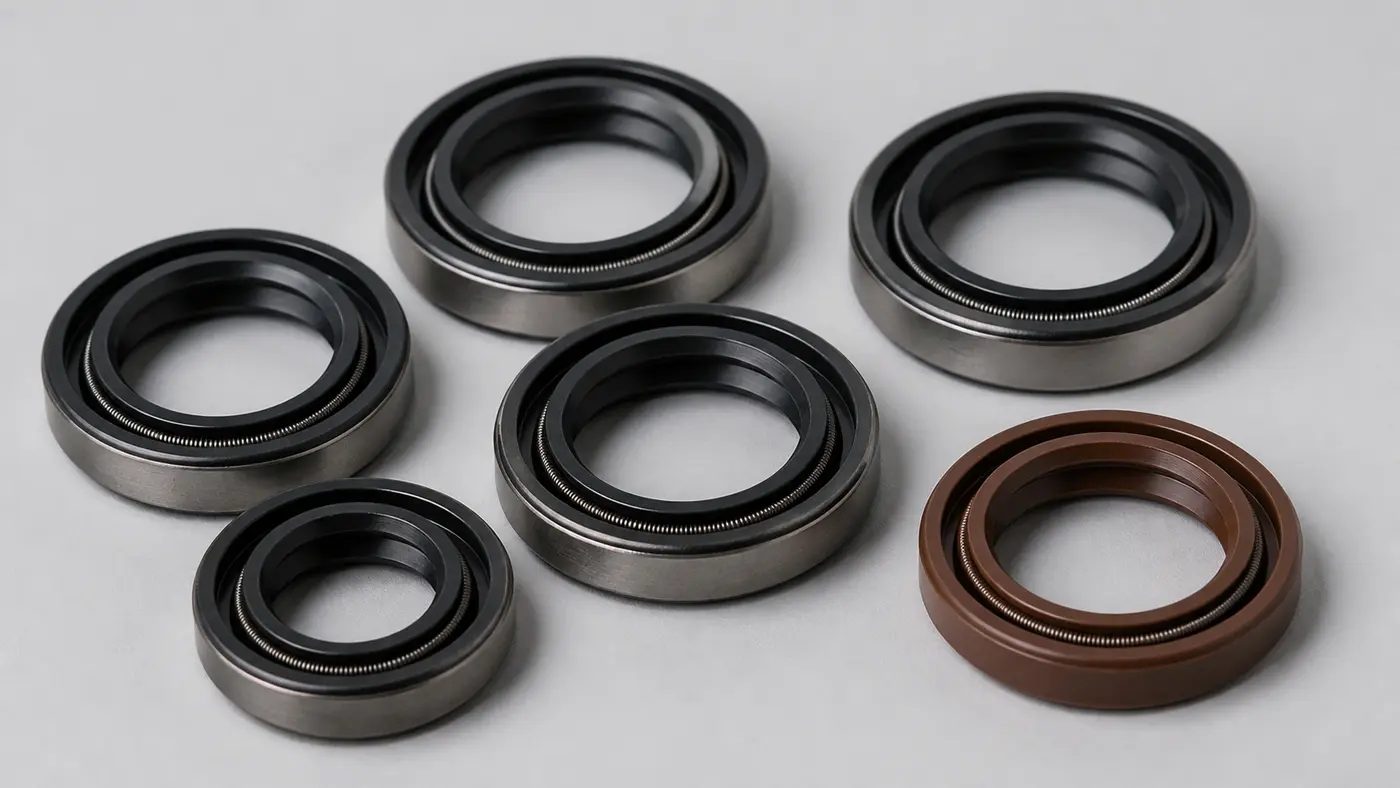 Illustrative product view
Product overview
Gearbox oil seals — also called rotary shaft seals or radial lip seals — are the components that close the gap where a shaft leaves the gearbox housing. Each seal combines an elastomeric sealing lip, a metal or reinforced outer case and, in most designs, a garter spring that keeps the lip in light contact with the rotating shaft.
Inside a gearbox, oil is splashed or pumped onto gears and bearings. The seal holds that lubricant in the housing while the shaft turns, and at the same time limits the entry of dust, water, grit and wash-down spray. Because the sealing lip runs directly on the shaft, it also helps keep the shaft surface and the bearings behind it protected from abrasive contamination.
Selection matters more than the part's small size suggests. A seal that is the wrong size for the shaft or bore, made from an elastomer that is not compatible with the lubricant, or fitted to a worn shaft surface may leak well before its expected life. Matching dimensions, material, lip design and shaft condition to the actual duty is what keeps a gearbox dry and service intervals predictable.
Functions & benefits
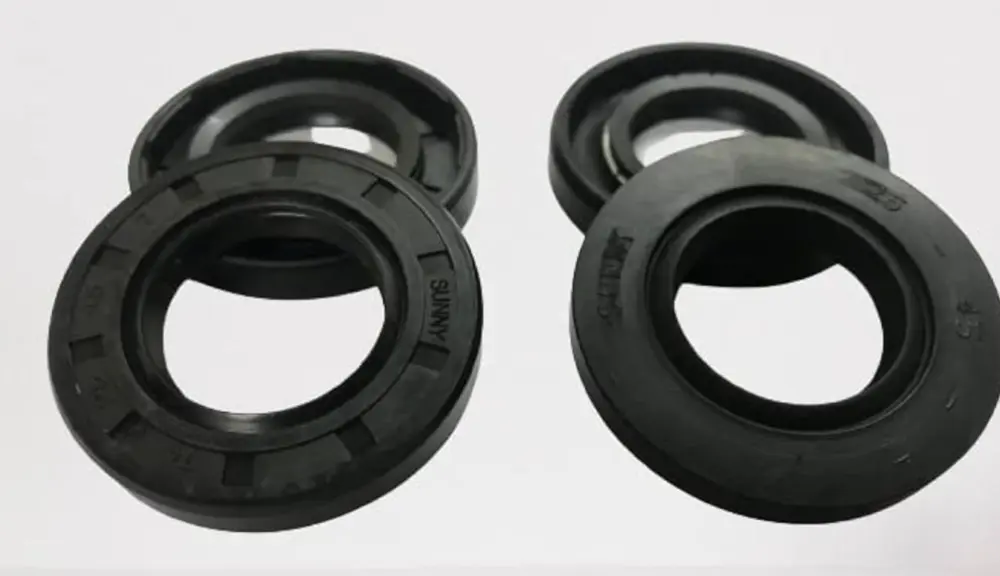
A gearbox seal is a small, low-cost part with an outsized effect on reliability. These are the jobs it performs and why each one matters on a working machine.
The lip holds oil inside the housing while the shaft rotates. Keeping the oil level stable means gears and bearings stay properly lubricated between service intervals, rather than running starved and hot.
Dust, grit, water and wash-down chemicals are kept away from the sealing zone. Fewer particles reaching the lip and bearings reduces abrasive wear and the risk of the seal itself being damaged.
Sealing keeps the lubricant film and the bearing environment clean. A protected shaft surface and clean oil support smoother running and help avoid the vibration and noise that follow bearing damage.
A correctly fitted seal helps a gearbox run without oil loss or ingress between planned maintenance stops. That supports steadier operation, cleaner surroundings and fewer unplanned shutdowns.
NBR covers many mineral-oil duties, while FKM is chosen where temperatures or fluids are more demanding. Selecting the compound to match the lubricant and environment is central to seal life.
Single lip, double lip, metal-cased and rubber-covered designs each suit different housings and dirt levels. Availability is confirmed against your dimensions, duty and quantity.
Product categories
The categories below describe the configurations commonly used in gearbox and transmission sealing. Suitability for a specific gearbox is confirmed against the shaft and bore dimensions, lubricant, temperature and speed of that unit.
Nitrile rubber (NBR) is the most widely used elastomer for rotary shaft seals in gearboxes running mineral-based lubricating oils. It offers good resistance to oils and greases in many general industrial and automotive duties, and is a practical starting point where temperatures and fluids are moderate.
Suitability still depends on the specific lubricant, the operating temperature and conditions such as shaft speed and dirt exposure. Additive packages and synthetic fluids should be checked against the seal compound before a large order.
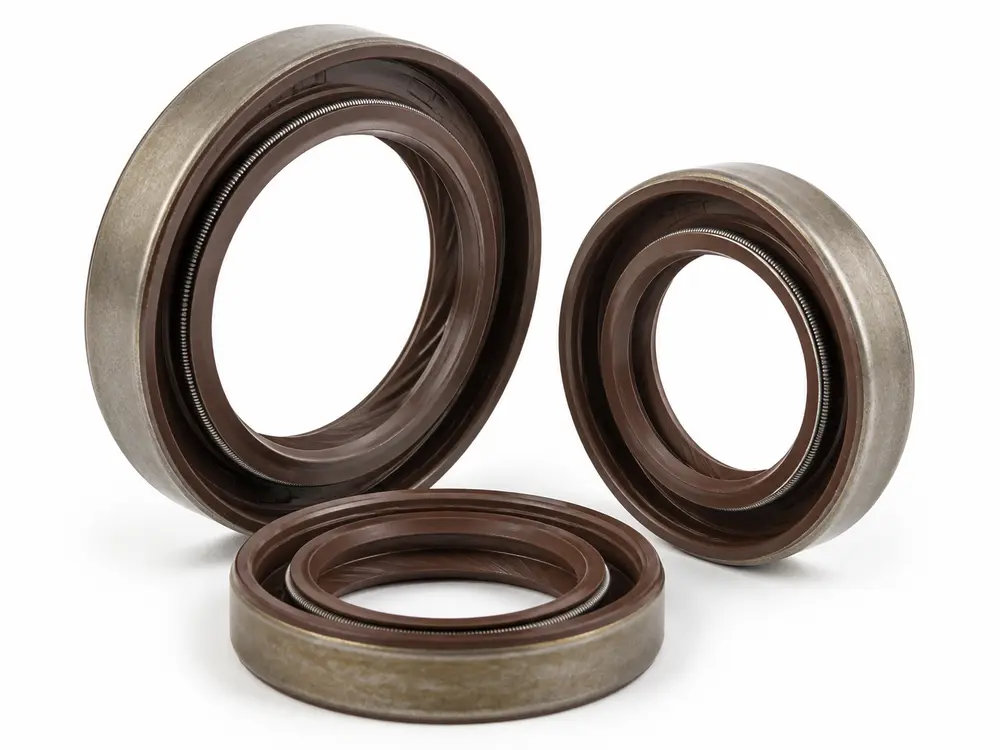
FKM (fluoroelastomer, often referred to as Viton® type) is selected where the seal must tolerate higher temperatures or more aggressive fluids than conventional NBR can handle. It is common in gearboxes and transmissions that run hot or use certain synthetic lubricants.
Resistance varies between FKM grades, so the compound should be matched to the actual fluid and temperature. Where a fluid is unusual, confirm compatibility with the material supplier before ordering.
A double lip seal carries the main sealing lip plus an additional lip, usually facing outward. The main lip retains lubricant; the secondary lip can act as a dust or exclusion lip and, in some designs, as a back-up sealing edge.
This arrangement is often considered where the shaft sees dust, mud, water spray or wash-down. The extra lip adds drag and needs its own lubrication in some designs, so the seal style must match the housing and duty.
The input shaft is where power enters the gearbox, usually from an engine, motor or drive coupling. Its seal closes the housing around that shaft and keeps oil from escaping towards the clutch, coupling or motor side.
Because the input side often runs at higher speed and may be exposed to the surrounding environment, shaft surface finish, concentricity and the choice of lip design all affect how well the seal performs.
The output shaft delivers torque to the driven machine — a conveyor, agitator, wheel axle or pump. Its seal retains lubricant at the output interface, where dirt, water and high load are often present.
Output shaft seals may be exposed to mud, slurry or wash-down, and to shaft deflection under load. A robust lip design, suitable material and correct fit in the housing are important in these positions.
Where a standard size does not fit, seals can be selected or supplied to non-standard shaft and housing dimensions, specified materials and a required lip configuration. Custom requirements are reviewed against the measurements and duty you provide.
Share the shaft diameter, bore, width, lubricant, temperature, speed and quantity, plus a sample or drawing of the existing seal where possible. That information is what allows a suitable configuration to be identified.
Material selection
NBR and FKM cover most gearbox and transmission sealing duties. The right choice is not only about temperature — the lubricant, additive package, shaft speed, surface finish and surrounding environment all influence how long a seal performs.
Nitrile butadiene rubber
Fluorocarbon rubber (Viton® type)
Actual temperature capability, swell and chemical resistance depend on the compound formulation, lubricant, temperature, shaft conditions, pressure and operating environment. We do not publish universal temperature limits for NBR or FKM — the compound datasheet and the equipment manufacturer's specification should be the reference for a specific application.
Comparison
Both positions use rotary shaft seals, but they rarely see the same duty. The comparison below sets out the usual differences a buyer should check before ordering.
| Parameter | Input Shaft Oil Seal | Output Shaft Oil Seal |
|---|---|---|
| Typical location | At the point where the input shaft enters the gearbox housing, usually towards the motor, engine or coupling side. | At the point where the output shaft leaves the housing, towards the driven machine, wheel, drum or conveyor drive. |
| Primary sealing purpose | Retains lubricant on the input side and keeps oil away from the coupling, clutch or motor area. | Retains lubricant at the output interface and limits dirt, water or slurry entry around the working shaft. |
| Relevant dimensional considerations | Shaft diameter, bore diameter and width as measured at the input bearing housing; the seal seat is often smaller. | Shaft diameter, bore diameter and width at the output bearing housing; sizes are frequently larger than on the input side. |
| Speed and surface factors | Often runs at higher speed, so shaft finish, concentricity and lip design have a strong influence on sealing. | Often runs at lower speed but higher torque; shaft deflection and contamination are more likely to affect the lip. |
| Common selection factors | Speed rating, low-friction lip design, lubricant type and the temperature near the drive coupling. | Dirt and water exclusion, robust lip or double lip design, material resistance and housing fit. |
| What to confirm before ordering | Measured shaft and bore, seal width, lubricant, operating temperature and direction of rotation where a helical lip is used. | Measured shaft and bore, seal width, exposure to mud or wash-down, load conditions and required material. |
On a narrow screen, scroll the table sideways to read all three columns.
Where they are used
Rotary shaft seals appear wherever a shaft passes through an oil-filled housing. These are the equipment categories where gearbox and transmission oil seals are most often specified.
Retain lubricant around input and output shafts on foot-mounted and flange-mounted units used across plant machinery.
Selection considers oil type, continuous operating temperature, shaft speed and the level of dust around the installation.
Seal gearbox, differential and transmission shafts against oil loss and road contamination in cars, trucks and buses.
Space constraints, higher speeds and exposure to water and grit make lip design and material choice important.
Close the housing where slow-speed, high-torque shafts leave a reducer, retaining oil in the sump.
Low speed can reduce oil supply at the lip, while high torque increases shaft deflection — both affect the seal choice.
Seal drive and tail pulley gearboxes where dust, spillage and wash-down are part of daily operation.
A double lip or dust lip arrangement and a material suited to the site conditions are usually worth reviewing.
Protect gearbox and transmission shafts on tractors, rotavators and implements working in soil, mud and crop residue.
Heavy contamination and outdoor temperature swings call for robust exclusion and a compatible elastomer.
Seal shafts on pump, fan, mixer and machine-tool drives where a gearbox or geared motor is used.
Duty cycle, lubricant and surrounding process fluids determine the lip configuration and material.
Buyer's guide
Work through these points in order. Most sealing problems trace back to one of them — a dimension taken from the wrong surface, a lubricant the compound does not suit, or a shaft that is too rough for the lip.
Measure the shaft where the lip actually runs, not a worn or corroded area. This is the seal's inner diameter.
Measure the bore in the housing that receives the seal's outer diameter, and check for scoring or damage.
Confirm the axial depth available. A wider seal may foul a shoulder or bearing; a narrower one may sit poorly.
Check the maximum surface speed at the lip. Higher speeds need a suitable lip design and heat management.
Use the temperature at the seal, including start-up and peak conditions, to narrow the elastomer choice.
Identify the oil grade, base stock and additives, then confirm the seal compound is compatible with them.
Surface roughness, hardness, runout and wear grooves all affect lip life. A worn shaft may need a repair sleeve.
Note any internal pressure, wash-down, dust, mud or chemical exposure that the seal will face in service.
Decide whether a single lip, double lip, dust lip or helical lip suits the speed, dirt level and rotation.
Where a part number or drawing exists, use it. Manufacturer data overrides assumptions from the gearbox model.
Gearbox oil seal dimensions should not be estimated solely from the gearbox model name when reliable dimensional information is available. Variants of the same model can use different shafts and housings. Measure the shaft, bore and width, or use the equipment manufacturer's part data, before ordering.
Send your shaft diameter, bore, seal width, lubricant and operating temperature. Our team will review the requirement and help you identify a suitable gearbox oil seal.
Non-standard requirements
When a standard catalogue size does not match the shaft, housing or duty, a custom requirement can be discussed. The clearer your specification, the faster a suitable configuration can be identified.
Custom requirements usually involve one or more of the following: a shaft or bore outside standard size ranges, a specific elastomer for the lubricant in use, a particular lip arrangement for dusty or wet conditions, or a seal width set by the housing depth.
Customisation is not only about dimensions. The material grade, lip geometry, spring type and outer case style all influence how the seal behaves at speed and temperature, so these should be described together rather than one at a time.
Gather this information before you contact us. It helps avoid back-and-forth and makes the requirement easier to review.
Working with us
Ananta Venture is a Delhi-based manufacturer of rubber oil seals and V belts for industrial, automotive, agricultural and heavy machinery applications. The support we offer around gearbox oil seals is practical and specification-led.
Share the shaft, bore and width with the application details, and we will help you read the requirement against the seal formats we work with.
Tell us the lubricant and the temperature the seal will see, and we will help narrow the choice between NBR, FKM and other options.
Seals for plant maintenance, machinery builders, workshops and trade buyers, supplied from our Burari, Delhi base.
Non-standard sizes, specific materials and particular lip arrangements can be discussed against your measurements and duty.
Quantity requirements can be shared directly by phone, WhatsApp or the contact page, along with the sizes and material needed.
Reach the team on +91 9211305366 from West Sant Nagar, Burari, Delhi — no call centre between you and the requirement.
Dimensions & specifications
Gearbox oil seal dimensions are normally written as inner diameter × outer diameter × width. These three measurements generally correspond to the shaft diameter, the housing bore diameter and the seal width, subject to the seal design and the measurement convention used by the manufacturer.
A seal in this format is intended for a 25 mm shaft, a 40 mm housing bore and a 7 mm seal width. This is an illustrative example, not a confirmed Ananta Venture product specification.
Always verify dimensions against the equipment manufacturer's documentation or the actual component. Seal widths in particular vary between designs, and the same nominal size can differ in case style or lip arrangement.
Common questions
Short answers to the questions buyers ask most often about gearbox and transmission oil seals.
Gearbox oil seals close the gap where a shaft passes through the gearbox housing. They retain lubricating oil inside the housing and help keep dust, water and other contaminants out, protecting the shaft surface and nearby bearings.
NBR (nitrile rubber) is widely used with mineral-based lubricating oils in moderate operating conditions. FKM (fluoroelastomer) is often chosen where higher temperatures or more aggressive fluids are involved. The right choice depends on the actual compound, lubricant, temperature and shaft conditions.
Measure the shaft diameter, the housing bore diameter and the seal width, then check them against the equipment manufacturer's documentation. The usual format is inner diameter × outer diameter × width, so a 25 × 40 × 7 mm seal is intended for a 25 mm shaft in a 40 mm bore with a 7 mm seal width.
The input shaft takes power into the gearbox and the output shaft delivers it to the driven machine. Both use rotary shaft seals, but speed, load, lubrication and housing design can differ, so the seal size, lip design and material are selected for each position.
They belong to the same family of rotary shaft seals. Gearbox oil seals are used in gearboxes and reduction units, while transmission oil seals serve gearboxes and transmission assemblies in vehicles and machinery. The correct seal still depends on dimensions and operating conditions.
Seals can be selected or supplied to non-standard dimensions, material requirements and lip configurations. Share your shaft and bore measurements, operating conditions and quantity so the requirement can be reviewed.
Provide the shaft diameter, bore diameter and seal width, along with the lubricant type, operating temperature, shaft speed where available, the equipment or gearbox application and the quantity required. A sample or a photo of the existing seal also helps.
Ananta Venture is based in West Sant Nagar, Burari, Delhi and can be reached by phone or WhatsApp on +91 9211305366, or through the contact page on this website. Share your dimensions and application details so the requirement can be reviewed.
Next step
Share your required dimensions, material preference, and operating conditions to help identify a suitable gearbox oil seal for your application.
Prefer to speak? Call +91 9211305366. Please share dimensions and quantity so the requirement can be reviewed properly.